Ch 25: The Electric Potential
Knight Calc - Physics for Scientists and Engineers 5th Edition
Knight Calc5th EditionPhysics for Scientists and EngineersISBN: 9780137344796Non è quello che usi tu?Cambia libro di testo
Capitolo 25, Problema 33

Two small charged spheres are 5.0 cm apart. One is charged to +25 nC, the other to −15 nC. A proton is released from rest halfway between the spheres. What is the proton's speed after it has moved 1.0 cm?

Guida verificata passo dopo passo
1
Step 1: Calculate the electric field at the midpoint between the two spheres due to each charge. Use the formula for the electric field due to a point charge: E=kqr2, where k is Coulomb's constant, q is the charge, and r is the distance from the charge to the point of interest.
Step 2: Determine the net electric field at the midpoint by adding the contributions from both charges. Remember that the electric field vectors will point away from positive charges and toward negative charges, so their directions must be considered when summing.
Step 3: Calculate the force acting on the proton due to the net electric field using the formula: F=qE, where q is the charge of the proton and E is the net electric field.
Step 4: Use Newton's second law to find the acceleration of the proton: a=Fm, where F is the force and m is the mass of the proton.
Step 5: Use kinematic equations to calculate the proton's speed after it has moved 1.0 cm. Use the equation: v2=v0+2ad, where v is the final speed, v0 is the initial speed (zero in this case), a is the acceleration, and d is the distance moved (1.0 cm).

Risposta video verificata per un problema simile:

Questa soluzione video è stata consigliata dai nostri tutor come utile per risolvere questo problema.

Concetti chiave

Ecco i concetti essenziali che devi comprendere per rispondere correttamente alla domanda.

Coulomb's Law

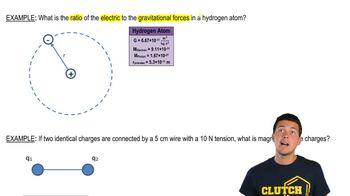
Coulomb's Law describes the electrostatic force between two charged objects. It states that the force is directly proportional to the product of the magnitudes of the charges and inversely proportional to the square of the distance between them. This law is essential for calculating the forces acting on the proton due to the charged spheres.
Video consigliato:

Electric Potential Energy

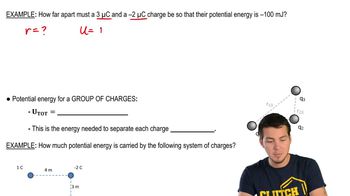
Electric potential energy is the energy a charged particle possesses due to its position in an electric field. It is calculated based on the charges involved and their separation distance. Understanding how potential energy changes as the proton moves is crucial for determining its speed after moving 1.0 cm.
Video consigliato:
Percorso guidato
07:51
Electric Potential Energy

Kinematics and Energy Conservation

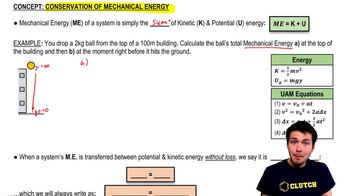
Kinematics involves the study of motion, while energy conservation principles state that the total mechanical energy in a closed system remains constant. In this scenario, the potential energy lost by the proton as it moves will convert into kinetic energy, allowing us to calculate its speed after moving a certain distance.
Video consigliato:
Percorso guidato
06:24
Conservation Of Mechanical Energy