Ch 25: The Electric Potential
Knight Calc - Physics for Scientists and Engineers 5th Edition
Knight Calc5th EditionPhysics for Scientists and EngineersISBN: 9780137344796Non è quello che usi tu?Cambia libro di testo
Capitolo 25, Problema 23a

Two 2.00 cm×2.00 cm plates that form a parallel-plate capacitor are charged to ±0.708 nC. What are the electric field strength inside and the potential difference across the capacitor if the spacing between the plates is 1.00 mm?

Guida verificata passo dopo passo
1
Step 1: Understand the problem. You are tasked with finding the electric field strength and the potential difference across a parallel-plate capacitor. The given values are the charge on the plates (±0.708 nC), the dimensions of the plates (2.00 cm × 2.00 cm), and the spacing between the plates (1.00 mm).
Step 2: Calculate the area of the plates. The area of a rectangular plate is given by the formula: A=l×w, where l and w are the length and width of the plate. Convert the dimensions from cm to m before calculating.
Step 3: Use the formula for the electric field strength inside a parallel-plate capacitor: E=σ/ε0, where σ is the surface charge density and ε0 is the permittivity of free space (ε0=8.85×10⁻¹²C/N·m2). First, calculate σ=Q/A, where Q is the charge and A is the area of the plates.
Step 4: Calculate the potential difference across the plates using the formula: V=E×d, where E is the electric field strength and d is the distance between the plates (convert 1.00 mm to meters before using it in the calculation).
Step 5: Review the formulas and ensure all units are consistent (e.g., meters for distance, square meters for area, coulombs for charge). Substitute the values into the formulas to find the electric field strength and potential difference.

Risposta video verificata per un problema simile:

Questa soluzione video è stata consigliata dai nostri tutor come utile per risolvere questo problema.
Durata del video:
11m

Concetti chiave

Ecco i concetti essenziali che devi comprendere per rispondere correttamente alla domanda.

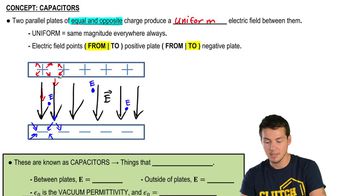
Electric Field in a Capacitor

The electric field (E) between the plates of a parallel-plate capacitor is uniform and can be calculated using the formula E = V/d, where V is the potential difference and d is the separation between the plates. The strength of the electric field indicates how much force a charge would experience in the field, and it is measured in volts per meter (V/m).
Video consigliato:
Percorso guidato
06:13
Intro to Capacitors

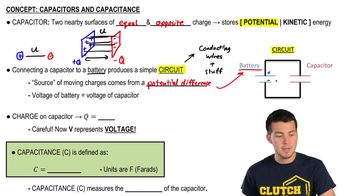
Capacitance

Capacitance (C) is a measure of a capacitor's ability to store charge per unit voltage, defined by the formula C = Q/V, where Q is the charge stored and V is the potential difference across the plates. For parallel-plate capacitors, capacitance can also be expressed as C = ε₀(A/d), where ε₀ is the permittivity of free space, A is the area of the plates, and d is the distance between them.
Video consigliato:
Percorso guidato
08:02
Capacitors & Capacitance (Intro)

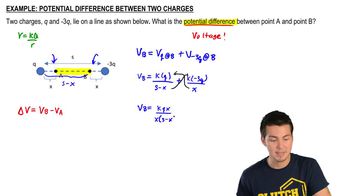
Potential Difference

The potential difference (V) across a capacitor is the work done to move a unit charge from one plate to the other. It is directly related to the charge stored and the capacitance of the capacitor. In this context, knowing the charge and the area of the plates allows for the calculation of the potential difference, which is crucial for determining the electric field strength.
Video consigliato:
Percorso guidato
07:04
Potential Difference Between Two Charges