Ch 26: Potential and Field
Knight Calc - Physics for Scientists and Engineers 5th Edition
Knight Calc5th EditionPhysics for Scientists and EngineersISBN: 9780137344796Non è quello che usi tu?Cambia libro di testo
Capitolo 26, Problema 78c

An electric dipole at the origin consists of two charges ±q spaced distance s apart along the y-axis. Assuming s≪x and y, find expressions for Ex and Ey, the components of Ē for a dipole.

Guida verificata passo dopo passo
1
Step 1: Begin by understanding the electric dipole setup. The dipole consists of two charges, +q and -q, separated by a distance s along the y-axis. The electric field at a point (x, y) is the vector sum of the fields due to each charge.
Step 2: Write the expression for the electric field due to a single charge. The electric field at a point (x, y) due to a charge q located at (0, s/2) is given by: E = k q / r 2 where r is the distance from the charge to the point (x, y).
Step 3: Approximate the distances to the charges using the assumption s ≪ x and y. For the positive charge at (0, s/2), the distance to the point (x, y) is approximately: r ≈ x 2 + y 2 Similarly, for the negative charge at (0, -s/2), the distance is approximately the same.
Step 4: Calculate the components of the electric field. The x-component of the field, Ex, is the sum of the contributions from both charges. Due to symmetry, the y-components of the fields from the two charges will partially cancel, leaving a net Ey component proportional to the dipole moment. Use the dipole approximation formula: E = k ( p ) / r 3 where p = qs is the dipole moment.
Step 5: Combine the results to express Ex and Ey. For Ex, the field is proportional to the dipole moment and inversely proportional to the cube of the distance. For Ey, the field depends on the orientation of the dipole relative to the point (x, y). Use trigonometric relationships to finalize the expressions for Ex and Ey in terms of q, s, x, and y.

Risposta video verificata per un problema simile:

Questa soluzione video è stata consigliata dai nostri tutor come utile per risolvere questo problema.
Durata del video:
13m

Concetti chiave

Ecco i concetti essenziali che devi comprendere per rispondere correttamente alla domanda.

Electric Dipole

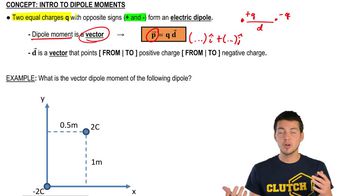
An electric dipole consists of two equal and opposite charges separated by a small distance. It is characterized by its dipole moment, which is a vector quantity pointing from the negative charge to the positive charge. The dipole moment is defined as p = q * d, where q is the charge and d is the separation distance. Understanding the dipole's configuration is crucial for analyzing the electric field it generates.
Video consigliato:
Percorso guidato
03:08
Intro To Dipole Moment

Electric Field Components

The electric field (E) produced by a dipole can be expressed in terms of its components along the x and y axes, denoted as Ex and Ey. These components describe how the electric field varies in different directions in space. For a dipole, the electric field components can be derived using the principle of superposition, considering the contributions from both charges at a point in space.
Video consigliato:
Percorso guidato
05:23
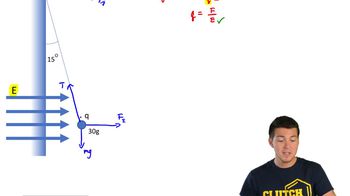
Balancing a Pendulum in Electric Field

Approximation for s ≪ x and y

The condition s ≪ x and y implies that the distance between the charges (s) is much smaller than the distances from the dipole to the point of interest (x and y). This allows for simplifications in the calculations of the electric field components, as higher-order terms can be neglected. This approximation is essential for deriving the expressions for Ex and Ey in a dipole's electric field.
Video consigliato:
Percorso guidato
04:05
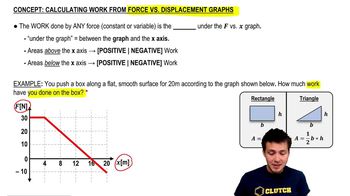
Calculating Work As Area Under F-x Graphs
Pratica correlata
Domanda del libro di testo

An electric dipole at the origin consists of two charges ±q spaced distance s apart along the y-axis. What is the field Ē on the bisecting axis? Does your result agree with Equation 23.11?

125
views

Domanda del libro di testo

Consider a uniformly charged sphere of radius R and total charge Q. The electric field Eout outside the sphere (r≥R) is simply that of a point charge Q. In Chapter 24, we used Gauss’s law to find that the electric field Ein inside the sphere (r≤R) is radially outward with field strength Ein=14πϵ0QR3rEin=\(\frac{1}{4\pi\epsilon_0}\)\(\frac{Q}{R^3}\)r. What is the ratio Vcenter/Vsurface?

1930
views
Domanda del libro di testo

Derive Equation 26.33 for the induced surface charge density on the dielectric in a capacitor.

108
views
Domanda del libro di testo

A vacuum-insulated parallel-plate capacitor with plate separation d has capacitance C0. What is the capacitance if an insulator with dielectric constant κ and thickness d/2 is slipped between the electrodes without changing the plate separation?

93
views
Domanda del libro di testo

Charge is uniformly distributed with charge density ρ inside a very long cylinder of radius R. Find the potential difference between the surface and the axis of the cylinder.

112
views
Domanda del libro di testo

An electric dipole at the origin consists of two charges ±q spaced distance s apart along the y-axis. Find an expression for the potential V(x, y) at an arbitrary point in the xy-plane. Your answer will be in terms of q, s, x, and y.

1852
views