
Ch 26: Potential and Field
Knight Calc - Physics for Scientists and Engineers 5th Edition
Knight Calc5th EditionPhysics for Scientists and EngineersISBN: 9780137344796Non è quello che usi tu?Cambia libro di testo
Capitolo 26, Problema 78e

An electric dipole at the origin consists of two charges ±q spaced distance s apart along the y-axis. What is the field Ē on the bisecting axis? Does your result agree with Equation 23.11?

Guida verificata passo dopo passo
1
Define the electric dipole: An electric dipole consists of two charges, +q and -q, separated by a distance s. The bisecting axis is the x-axis, which is perpendicular to the line joining the charges and passes through the midpoint of the dipole.
Write the expression for the electric field due to a point charge: The electric field at a distance r from a point charge q is given by \( E = \frac{1}{4\pi\epsilon_0} \frac{q}{r^2} \), where \( \epsilon_0 \) is the permittivity of free space.
Determine the contributions of the two charges to the electric field on the bisecting axis: The distance from each charge to a point on the x-axis is \( r = \sqrt{x^2 + (s/2)^2} \). The electric field due to each charge has both x and y components. The y-components cancel out because the charges are opposite in sign, leaving only the x-components.
Calculate the x-component of the electric field: The x-component of the electric field due to each charge is \( E_x = E \cos\theta \), where \( \cos\theta = \frac{x}{\sqrt{x^2 + (s/2)^2}} \). Combine the contributions from both charges to find the net electric field along the x-axis.
Simplify the expression for the net electric field: After combining the contributions and simplifying, the result should match Equation 23.11, which states that the electric field on the bisecting axis of a dipole is \( E = \frac{1}{4\pi\epsilon_0} \frac{2qxs}{(x^2 + (s/2)^2)^{3/2}} \). Verify that your derived expression agrees with this result.

Risposta video verificata per un problema simile:

Questa soluzione video è stata consigliata dai nostri tutor come utile per risolvere questo problema.
Durata del video:
5m

Concetti chiave

Ecco i concetti essenziali che devi comprendere per rispondere correttamente alla domanda.

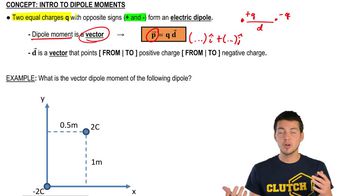
Electric Dipole

An electric dipole consists of two equal and opposite charges separated by a distance. It is characterized by its dipole moment, which is a vector quantity pointing from the negative to the positive charge. The electric field generated by a dipole varies with distance and direction, and it is crucial for understanding how dipoles interact with external electric fields.
Video consigliato:
Percorso guidato
03:08
Intro To Dipole Moment

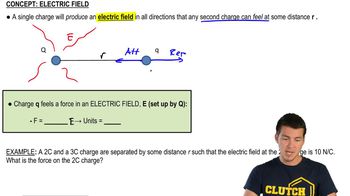
Electric Field

The electric field (E) is a vector field that represents the force per unit charge experienced by a positive test charge placed in the field. For a dipole, the electric field can be calculated at various points in space, including the bisecting axis, where the field's behavior is influenced by the orientation and distance from the dipole. Understanding how to derive the electric field from a dipole is essential for solving related problems.
Video consigliato:
Percorso guidato
03:16
Intro to Electric Fields

Equation 23.11

Equation 23.11 likely refers to a specific formula in the context of electric dipoles, typically relating to the electric field produced by a dipole at a certain point in space. This equation provides a mathematical framework for calculating the electric field based on the dipole moment and the distance from the dipole. Comparing the derived field on the bisecting axis with this equation helps validate the theoretical understanding of dipole fields.
Video consigliato:
Percorso guidato
08:25
Kinematics Equations