
Ch 26: Potential and Field
Knight Calc - Physics for Scientists and Engineers 5th Edition
Knight Calc5th EditionPhysics for Scientists and EngineersISBN: 9780137344796Non è quello che usi tu?Cambia libro di testo
Capitolo 26, Problema 48

The electric field in a region of space is E→=(800xı^−600yȷ^)\(\overrightarrow{E}\)=(800xî-600yĵ) V/m , where x and y are in m. The zero of electric potential is at the origin. What are (a) the electric field and (b) the electric potential at the point (x,y)=(2.0 m, 1.0 m)? Hint: The potential difference is the same along any path connecting two points.

Guida verificata passo dopo passo
1
Step 1: Understand the problem. The electric field is given as a vector function Ē = (800x î − 600y ĵ) V/m, where x and y are in meters. You are tasked to find (a) the electric field at the point (x, y) = (2.0 m, 1.0 m) and (b) the electric potential at this point, given that the zero of electric potential is at the origin.
Step 2: To find the electric field at the point (x, y) = (2.0 m, 1.0 m), substitute x = 2.0 m and y = 1.0 m into the given electric field equation. The electric field components are: Eₓ = 800x and Eᵧ = −600y. Use these expressions to calculate the components of the electric field vector at the specified point.
Step 3: To find the electric potential at the point (x, y) = (2.0 m, 1.0 m), recall that the electric potential difference between two points is related to the electric field by the integral: V = −∫Ē ⋅ d𝐫. Since the zero of potential is at the origin, integrate the electric field along a path from the origin (0, 0) to the point (2.0 m, 1.0 m). Choose a convenient path, such as first moving along the x-axis and then along the y-axis, and compute the integral for each segment.
Step 4: Perform the integration for the electric potential. For the x-axis segment (from (0, 0) to (2.0, 0)), the electric field is Ē = 800x î, and the displacement is d𝐫 = dx î. The integral becomes Vₓ = −∫₀² (800x dx). For the y-axis segment (from (2.0, 0) to (2.0, 1.0)), the electric field is Ē = −600y ĵ, and the displacement is d𝐫 = dy ĵ. The integral becomes Vᵧ = −∫₀¹ (−600y dy). Add these two results to find the total potential at (2.0 m, 1.0 m).
Step 5: Combine the results. The electric field at (2.0 m, 1.0 m) is a vector with components Eₓ and Eᵧ, calculated in Step 2. The electric potential at (2.0 m, 1.0 m) is the sum of the integrals computed in Step 4. Ensure the units are consistent and verify the calculations for accuracy.

Risposta video verificata per un problema simile:

Questa soluzione video è stata consigliata dai nostri tutor come utile per risolvere questo problema.

Concetti chiave

Ecco i concetti essenziali che devi comprendere per rispondere correttamente alla domanda.

Electric Field

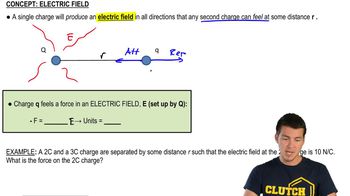
The electric field is a vector field that represents the force per unit charge experienced by a positive test charge placed in the field. It is defined mathematically as E = F/q, where E is the electric field, F is the force, and q is the charge. In this question, the electric field is given as a function of position, indicating how the field varies in space.
Video consigliato:
Percorso guidato
03:16
Intro to Electric Fields

Electric Potential

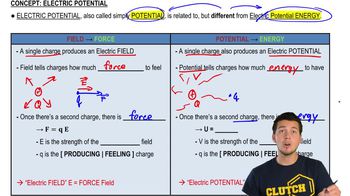
Electric potential, often referred to as voltage, is the amount of electric potential energy per unit charge at a point in an electric field. It is a scalar quantity and is related to the electric field by the equation V = -∫E·dr, where V is the potential, E is the electric field, and dr is the differential displacement vector. The potential difference between two points is crucial for determining the work done in moving a charge between them.
Video consigliato:
Percorso guidato
07:33
Electric Potential

Potential Difference

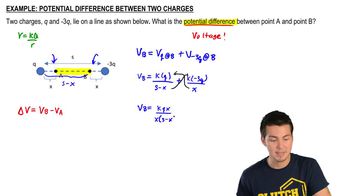
The potential difference between two points in an electric field is the work done in moving a unit charge from one point to another against the electric field. It is independent of the path taken, meaning that the potential difference is the same regardless of the route. This concept is essential for solving the problem, as it allows us to calculate the electric potential at a specific point using the electric field information provided.
Video consigliato:
Percorso guidato
07:04
Potential Difference Between Two Charges
Pratica correlata
Domanda del libro di testo

Engineers discover that the electric potential between two electrodes can be modeled as V(x)=V0ln(1+x/d) , where V0 is a constant, x is the distance from the first electrode in the direction of the second, and d is the distance between the electrodes. What is the electric field strength midway between the electrodes?

38
views
Domanda del libro di testo

Two positive point charges q are located on the y-axis at y = ±a. Your answer to part d shows that an electron experiences a linear restoring force, so it will undergo simple harmonic motion. What is the oscillation frequency in GHz for an electron moving between two 1.0 nC charges separated by 2.0 mm?

1625
views
Domanda del libro di testo

The electric potential in a region of space is V=(150x2 − 200y2)V, where x and y are in meters. What are the strength and direction of the electric field at (x, y)=(2.0 m, 2.0 m)? Give the direction as an angle cw or ccw (specify which) from the positive x-axis.

61
views
Domanda del libro di testo

Use the on-axis potential of a charged disk from Chapter 25 to find the on-axis electric field of a charged disk.

1821
views
Domanda del libro di testo

Two positive point charges q are located on the y-axis at y = ±a. Symmetry dictates that the electric field along the x-axis has only an x-component: Ey=Ez=0. Find an expression for Ex if x≪a.

66
views
Domanda del libro di testo

Two positive point charges q are located on the y-axis at y = ±a. Write an expression for the electric potential at position x on the x-axis.

1765
views