
Ch 26: Potential and Field
Knight Calc - Physics for Scientists and Engineers 5th Edition
Knight Calc5th EditionPhysics for Scientists and EngineersISBN: 9780137344796Non è quello che usi tu?Cambia libro di testo
Capitolo 26, Problema 45

The electric potential in a region of space is V=(150x2 − 200y2)V, where x and y are in meters. What are the strength and direction of the electric field at (x, y)=(2.0 m, 2.0 m)? Give the direction as an angle cw or ccw (specify which) from the positive x-axis.

Guida verificata passo dopo passo
1
The electric field **E** is related to the electric potential **V** by the negative gradient of the potential. Mathematically, this is expressed as: E = -\(\nabla\) V. The gradient operator in two dimensions is: \(\nabla\) V = \(\left\)(\(\frac{\partial V}{\partial x}\), \(\frac{\partial V}{\partial y}\)\(\right\)).
To find the x-component of the electric field, calculate the partial derivative of V with respect to x: \(\frac{\partial V}{\partial x}\) = \(\frac{\partial}{\partial x}\)(150x^2 - 200y^2) = 300x. Substituting x = 2.0 m, we get the x-component of the electric field.
To find the y-component of the electric field, calculate the partial derivative of V with respect to y: \(\frac{\partial V}{\partial y}\) = \(\frac{\partial}{\partial y}\)(150x^2 - 200y^2) = -400y. Substituting y = 2.0 m, we get the y-component of the electric field.
The magnitude of the electric field is given by: |E| = \(\sqrt{E_x^2 + E_y^2}\), where E_x and E_y are the x- and y-components of the electric field, respectively. Substitute the values of E_x and E_y to compute the magnitude.
The direction of the electric field is given by the angle \(\theta\) = \(\arctan\[\left\)(\(\frac{E_y}{E_x}\]\right\)). Determine the angle and specify whether it is clockwise (cw) or counterclockwise (ccw) from the positive x-axis based on the signs of E_x and E_y.

Risposta video verificata per un problema simile:

Questa soluzione video è stata consigliata dai nostri tutor come utile per risolvere questo problema.

Concetti chiave

Ecco i concetti essenziali che devi comprendere per rispondere correttamente alla domanda.

Electric Potential

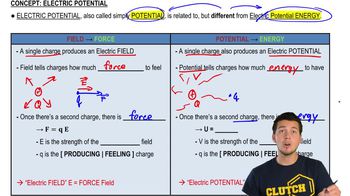
Electric potential, denoted as V, is the amount of electric potential energy per unit charge at a point in an electric field. It is a scalar quantity measured in volts (V) and indicates how much work would be done to move a charge from a reference point to a specific point in the field without any acceleration.
Video consigliato:
Percorso guidato
07:33
Electric Potential

Electric Field

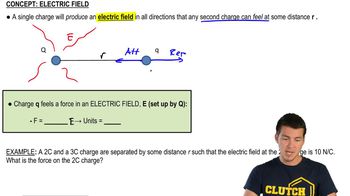
The electric field (E) is a vector field that represents the force experienced by a unit positive charge placed in the field. It is defined as the negative gradient of the electric potential, mathematically expressed as E = -∇V. The direction of the electric field is from regions of higher potential to lower potential.
Video consigliato:
Percorso guidato
03:16
Intro to Electric Fields

Gradient and Direction

The gradient of a scalar field, such as electric potential, indicates the direction and rate of change of that field. In the context of electric fields, the gradient is calculated using partial derivatives with respect to spatial coordinates. The angle of the electric field can be determined using trigonometric functions based on the components of the field in the x and y directions.
Video consigliato:
Percorso guidato
09:49
Direction of Current in Loop Equations
Pratica correlata
Domanda del libro di testo

Engineers discover that the electric potential between two electrodes can be modeled as V(x)=V0ln(1+x/d) , where V0 is a constant, x is the distance from the first electrode in the direction of the second, and d is the distance between the electrodes. What is the electric field strength midway between the electrodes?

38
views
Domanda del libro di testo

The electric field in a region of space is E→=(800xı^−600yȷ^)\(\overrightarrow{E}\)=(800xî-600yĵ) V/m , where x and y are in m. The zero of electric potential is at the origin. What are (a) the electric field and (b) the electric potential at the point (x,y)=(2.0 m, 1.0 m)? Hint: The potential difference is the same along any path connecting two points.

64
views
Domanda del libro di testo

An infinitely long cylinder of radius R has linear charge density λ. The potential on the surface of the cylinder is V0, and the electric field outside the cylinder is Er = λ/2πϵ0r . Find the potential relative to the surface at a point that is distance r from the axis, assuming r>R.

158
views
Domanda del libro di testo

Use the on-axis potential of a charged disk from Chapter 25 to find the on-axis electric field of a charged disk.

1821
views
Domanda del libro di testo

Two positive point charges q are located on the y-axis at y = ±a. Symmetry dictates that the electric field along the x-axis has only an x-component: Ey=Ez=0. Find an expression for Ex if x≪a.

66
views
Domanda del libro di testo

Two positive point charges q are located on the y-axis at y = ±a. Write an expression for the electric potential at position x on the x-axis.

1765
views