Ch 26: Potential and Field
Knight Calc - Physics for Scientists and Engineers 5th Edition
Knight Calc5th EditionPhysics for Scientists and EngineersISBN: 9780137344796Non è quello che usi tu?Cambia libro di testo
Capitolo 26, Problema 39a

The electric field in a region of space is Ex = −1000x^2 V/m, where x is in meters. Graph Ex versus x over the region −1 m ≤ x ≤1 m.

Guida verificata passo dopo passo
1
Understand the given electric field expression: The electric field is given as \( E_x = -1000x^2 \) V/m, where \( x \) is the position in meters. This means the electric field depends on the square of \( x \), and it is negative, indicating direction.
Identify the range for \( x \): The problem specifies the range \( -1 \leq x \leq 1 \) meters. This will be the domain for the graph.
Determine the behavior of \( E_x \): Since \( E_x = -1000x^2 \), the electric field is always negative (due to the \( -1000 \) factor) and symmetric about \( x = 0 \) because \( x^2 \) is an even function. The maximum magnitude of \( E_x \) occurs at \( x = \pm 1 \).
Calculate key points for the graph: Evaluate \( E_x \) at specific values of \( x \) within the range, such as \( x = -1, -0.5, 0, 0.5, 1 \). For example, at \( x = 0 \), \( E_x = -1000(0)^2 = 0 \); at \( x = 1 \), \( E_x = -1000(1)^2 = -1000 \) V/m.
Plot the graph: On the horizontal axis, represent \( x \) from \( -1 \) to \( 1 \). On the vertical axis, represent \( E_x \) values. Plot the calculated points and connect them with a smooth curve, showing a parabolic shape opening downward (negative values) and symmetric about \( x = 0 \).

Risposta video verificata per un problema simile:

Questa soluzione video è stata consigliata dai nostri tutor come utile per risolvere questo problema.
Durata del video:
3m

Concetti chiave

Ecco i concetti essenziali che devi comprendere per rispondere correttamente alla domanda.

Electric Field

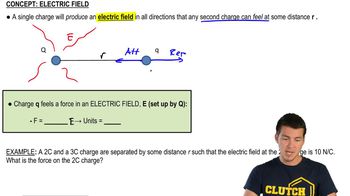
The electric field is a vector field that represents the force per unit charge experienced by a positive test charge placed in the field. It is defined mathematically as E = F/q, where E is the electric field, F is the force, and q is the charge. In this case, the electric field varies with position, specifically as a function of x, indicating how the force changes as the position changes.
Video consigliato:
Percorso guidato
03:16
Intro to Electric Fields

Graphing Functions

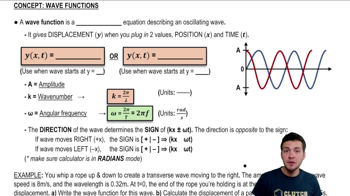
Graphing functions involves plotting points on a coordinate system to visualize the relationship between variables. In this context, we are graphing the electric field Ex as a function of position x. Understanding how to interpret the graph helps in analyzing the behavior of the electric field across the specified range, revealing trends such as symmetry and the nature of the field's variation.
Video consigliato:
Percorso guidato
08:30
Intro to Wave Functions

Quadratic Functions

A quadratic function is a polynomial function of degree two, typically expressed in the form f(x) = ax^2 + bx + c. The given electric field Ex = -1000x^2 V/m is a quadratic function where the coefficient of x^2 is negative, indicating that the graph will be a downward-opening parabola. Recognizing the characteristics of quadratic functions is essential for accurately graphing and interpreting the electric field's behavior.
Video consigliato:
Percorso guidato
5:13
Quadratic Equations