Ch 26: Potential and Field
Knight Calc - Physics for Scientists and Engineers 5th Edition
Knight Calc5th EditionPhysics for Scientists and EngineersISBN: 9780137344796Non è quello che usi tu?Cambia libro di testo
Capitolo 26, Problema 40

An infinitely long cylinder of radius R has linear charge density λ. The potential on the surface of the cylinder is V0, and the electric field outside the cylinder is Er = λ/2πϵ0r . Find the potential relative to the surface at a point that is distance r from the axis, assuming r>R.

Guida verificata passo dopo passo
1
Start by recalling the relationship between the electric field and the potential in electrostatics. The electric field is the negative gradient of the potential: \( E_r = -\frac{dV}{dr} \). Rearrange this to express the potential difference: \( dV = -E_r \, dr \).
Substitute the given expression for the electric field outside the cylinder, \( E_r = \frac{\lambda}{2\pi\epsilon_0 r} \), into the equation for \( dV \): \( dV = -\frac{\lambda}{2\pi\epsilon_0 r} \, dr \).
Integrate both sides to find the potential \( V(r) \) at a distance \( r \) from the axis. The integral becomes \( V(r) - V_0 = -\int_R^r \frac{\lambda}{2\pi\epsilon_0 r} \, dr \), where the limits of integration are from \( R \) (the surface of the cylinder) to \( r \) (the point of interest).
Evaluate the integral \( \int \frac{1}{r} \, dr \), which is \( \ln(r) \). Substituting this result, the equation becomes \( V(r) - V_0 = -\frac{\lambda}{2\pi\epsilon_0} [\ln(r) - \ln(R)] \).
Simplify the expression using the logarithmic property \( \ln(a) - \ln(b) = \ln(\frac{a}{b}) \). The final expression for the potential relative to the surface is \( V(r) = V_0 - \frac{\lambda}{2\pi\epsilon_0} \ln\left(\frac{r}{R}\right) \).

Risposta video verificata per un problema simile:

Questa soluzione video è stata consigliata dai nostri tutor come utile per risolvere questo problema.

Concetti chiave

Ecco i concetti essenziali che devi comprendere per rispondere correttamente alla domanda.

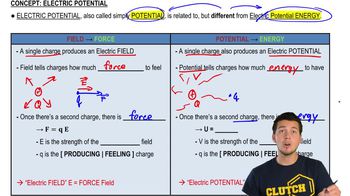
Electric Potential

Electric potential is the amount of electric potential energy per unit charge at a point in an electric field. It is a scalar quantity that indicates the work done to move a unit positive charge from a reference point to a specific point in the field. In this context, the potential on the surface of the cylinder is given as V0, which serves as a reference for calculating the potential at a distance r from the axis.
Video consigliato:
Percorso guidato
07:33
Electric Potential

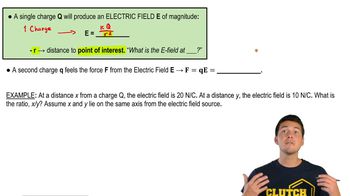
Electric Field of a Charged Cylinder

The electric field outside an infinitely long charged cylinder is determined by its linear charge density (λ) and is given by the formula Er = λ/(2πϵ0 r). This field decreases with distance from the cylinder and is directed radially outward. Understanding this relationship is crucial for calculating the potential at a distance r from the cylinder's axis.
Video consigliato:
Percorso guidato
06:28
Electric Field due to a Point Charge

Integration in Electrostatics

In electrostatics, the potential difference between two points can be found by integrating the electric field along a path between those points. For a charged cylinder, this involves integrating the electric field from the surface (r = R) to the point at distance r. This process allows us to determine how the potential changes with distance in the presence of an electric field.
Video consigliato:
Percorso guidato
11:43
Finding Moment Of Inertia By Integrating