Ch 27: Current and Resistance
Knight Calc - Physics for Scientists and Engineers 5th Edition
Knight Calc5th EditionPhysics for Scientists and EngineersISBN: 9780137344796Non è quello che usi tu?Cambia libro di testo
Capitolo 27, Problema 15

A hollow copper wire with an inner diameter of 1.0 mm and an outer diameter of 2.0 mm carries a current of 10 A. What is the current density in the wire?

Guida verificata passo dopo passo
1
Determine the cross-sectional area of the hollow wire. The cross-sectional area is the difference between the area of the outer circle and the inner circle. Use the formula for the area of a circle: A = πr², where r is the radius. Convert the diameters to radii by dividing by 2, and ensure the units are in meters.
Calculate the area of the outer circle using the outer radius (r_outer = 2.0 mm / 2 = 1.0 mm = 0.001 m). Substitute this value into the formula A_outer = πr_outer².
Calculate the area of the inner circle using the inner radius (r_inner = 1.0 mm / 2 = 0.5 mm = 0.0005 m). Substitute this value into the formula A_inner = πr_inner².
Find the cross-sectional area of the hollow wire by subtracting the inner area from the outer area: A_hollow = A_outer - A_inner.
Determine the current density (J) using the formula J = I / A_hollow, where I is the current (10 A) and A_hollow is the cross-sectional area calculated in the previous step.

Risposta video verificata per un problema simile:

Questa soluzione video è stata consigliata dai nostri tutor come utile per risolvere questo problema.

Concetti chiave

Ecco i concetti essenziali che devi comprendere per rispondere correttamente alla domanda.

Current Density

Current density is defined as the amount of electric current flowing per unit area of a cross-section of a conductor. It is represented by the symbol 'J' and is calculated using the formula J = I/A, where 'I' is the current in amperes and 'A' is the cross-sectional area in square meters. Understanding current density is crucial for analyzing how current distributes within a conductor.
Video consigliato:
Percorso guidato
8:13
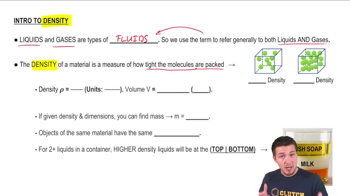
Intro to Density

Cross-Sectional Area

The cross-sectional area of a wire is the area of a slice taken perpendicular to its length. For a hollow cylindrical wire, the cross-sectional area can be calculated by subtracting the area of the inner circle from the area of the outer circle. This area is essential for determining the current density, as it directly influences how concentrated the current is within the wire.
Video consigliato:
Percorso guidato
08:10
Calculating the Vector (Cross) Product Using Components

Ohm's Law

Ohm's Law states that the current flowing through a conductor between two points is directly proportional to the voltage across the two points and inversely proportional to the resistance of the conductor. While the question focuses on current density, understanding Ohm's Law provides insight into the relationship between current, voltage, and resistance, which is fundamental in electrical circuits.
Video consigliato:
Percorso guidato
03:07
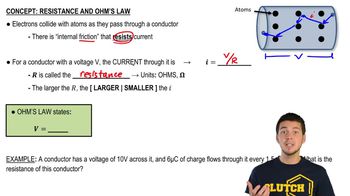
Resistance and Ohm's Law