Ch 27: Current and Resistance
Knight Calc - Physics for Scientists and Engineers 5th Edition
Knight Calc5th EditionPhysics for Scientists and EngineersISBN: 9780137344796Non è quello che usi tu?Cambia libro di testo
Capitolo 27, Problema 8c

The mean time between collisions for electrons in a gold wire is 25 fs, where 1 fs = 1 femtosecond = 10⁻¹⁵ s. How many times does the electron collide with an ion while moving this distance?

Guida verificata passo dopo passo
1
Understand the problem: The mean time between collisions (τ) is given as 25 fs, and we need to determine how many collisions occur over a certain time or distance. This requires understanding the relationship between time, velocity, and collisions.
Convert the given mean time between collisions into seconds: Since 1 femtosecond (fs) = 10⁻¹⁵ seconds, multiply 25 fs by 10⁻¹⁵ to express τ in seconds.
Determine the total time or distance over which the electron is moving (if not explicitly given, assume a hypothetical time or distance for calculation). The number of collisions is calculated as the total time divided by the mean time between collisions.
Use the formula for the number of collisions: \( N = \frac{T}{\tau} \), where \( T \) is the total time of motion and \( \tau \) is the mean time between collisions. Substitute the values into this formula.
Interpret the result: The calculated \( N \) represents the number of collisions the electron undergoes while moving over the specified time or distance. Ensure the units are consistent throughout the calculation.

Risposta video verificata per un problema simile:

Questa soluzione video è stata consigliata dai nostri tutor come utile per risolvere questo problema.

Concetti chiave

Ecco i concetti essenziali che devi comprendere per rispondere correttamente alla domanda.

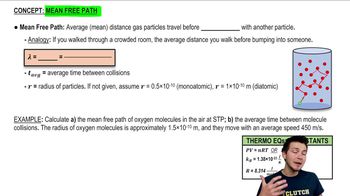
Mean Free Path

The mean free path is the average distance a particle travels between collisions. In the context of electrons in a conductor, it helps determine how often electrons interact with ions or other particles. This concept is crucial for understanding electrical conductivity and the behavior of charge carriers in materials.
Video consigliato:

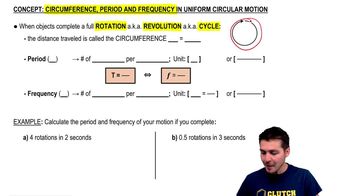
Collision Frequency

Collision frequency refers to the number of collisions a particle experiences per unit time. For electrons in a conductor, this is influenced by factors such as temperature and the density of ions. Understanding collision frequency is essential for calculating how many times an electron collides with ions over a given distance.
Video consigliato:
Percorso guidato
05:08
Circumference, Period, and Frequency in UCM

Drift Velocity

Drift velocity is the average velocity that a charged particle, such as an electron, attains due to an electric field. It is a key factor in determining how far an electron travels in a given time frame. By knowing the drift velocity and the mean time between collisions, one can calculate the total distance traveled and the number of collisions that occur.
Video consigliato:
Percorso guidato
7:27
Escape Velocity