
Ch 27: Current and Resistance
Knight Calc - Physics for Scientists and Engineers 5th Edition
Knight Calc5th EditionPhysics for Scientists and EngineersISBN: 9780137344796Non è quello che usi tu?Cambia libro di testo
Capitolo 27, Problema 37

The resistance of a very fine aluminum wire with a 10 μm ×10 μm square cross section is 1000 Ω . A 1000 Ω resistor is made by wrapping this wire in a spiral around a 3.0-mm-diameter glass core. How many turns of wire are needed?

Guida verificata passo dopo passo
1
Determine the resistivity of aluminum (ρ). For aluminum, the resistivity is approximately 2.65 × 10⁻⁸ Ω·m. This value will be used to calculate the length of the wire required to achieve the given resistance.
Use the formula for resistance: R=ρAL, where R is the resistance (1000 Ω), ρ is the resistivity of aluminum, A is the cross-sectional area of the wire, and L is the length of the wire. Calculate the cross-sectional area A using the given dimensions: A=10-6×10-6=10-12m2.
Rearrange the resistance formula to solve for the length of the wire: L=R×Aρ. Substitute the known values: R = 1000 Ω, A = 10⁻¹² m², and ρ = 2.65 × 10⁻⁸ Ω·m. This will give you the total length of the wire required.
Calculate the circumference of the glass core around which the wire is wrapped. The diameter of the core is given as 3.0 mm, so the radius is 1.5 mm or 1.5 × 10⁻³ m. The circumference is given by C=2πr, where r is the radius. Substitute r = 1.5 × 10⁻³ m to find the circumference.
Divide the total length of the wire (calculated in step 3) by the circumference of the glass core (calculated in step 4) to determine the number of turns of wire needed. This will give you the final answer for the number of turns.

Risposta video verificata per un problema simile:

Questa soluzione video è stata consigliata dai nostri tutor come utile per risolvere questo problema.

Concetti chiave

Ecco i concetti essenziali che devi comprendere per rispondere correttamente alla domanda.

Resistance

Resistance is a measure of the opposition to the flow of electric current in a conductor. It is determined by the material's properties, length, and cross-sectional area. In this case, the aluminum wire has a specified resistance of 1000 Ω, which is crucial for calculating how many turns of wire are needed to achieve the desired resistance in the resistor.
Video consigliato:
Percorso guidato
05:25
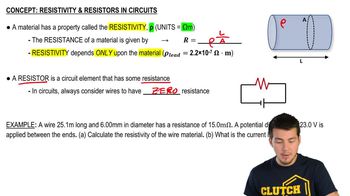
Resistivity & Resistors in Circuits

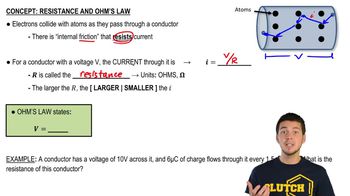
Ohm's Law

Ohm's Law states that the current (I) through a conductor between two points is directly proportional to the voltage (V) across the two points and inversely proportional to the resistance (R) of the conductor. This relationship is expressed as V = IR. Understanding this law is essential for analyzing circuits and determining how resistance affects current flow in the wire.
Video consigliato:
Percorso guidato
03:07
Resistance and Ohm's Law

Inductance and Coil Turns

The number of turns in a coil of wire affects its inductance, which is the property that quantifies the coil's ability to store energy in a magnetic field. In this scenario, the wire is wrapped around a glass core, and the total resistance of the coil is influenced by the number of turns. Calculating the required number of turns involves understanding how the geometry of the coil and the wire's resistance contribute to the overall resistance of the resistor.
Video consigliato:
Percorso guidato
12:59
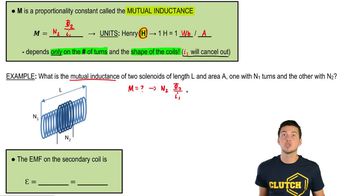
Mutual Induction
Pratica correlata
Domanda del libro di testo

A sculptor has asked you to help electroplate gold onto a brass statue. You know that the charge carriers in the ionic solution are singly charged gold ions, and you've calculated that you must deposit 0.50 g of gold to reach the necessary thickness. How much current do you need, in mA, to plate the statue in 3.0 hours?

85
views
Domanda del libro di testo

The electron beam inside an old television picture tube is 0.40 mm in diameter and carries a current of 50 μA. This electron beam impinges on the inside of the picture tube screen. How many electrons strike the screen each second?

65
views
Domanda del libro di testo

Thermistors, resistors whose resistance is a sensitive function of temperature, are widely used in industry and consumer devices to measure temperature. The resistance of a thermistor at temperature T can be modeled as R=R₀exp[β(1/T−1/T₀)], where T₀ is a reference temperature, the temperatures are in K, and β is a constant with units of K. Suppose you connect a thermistor to a 10.0 V battery and measure the current through it at different temperatures. At 25.0°C, which you select as your reference temperature, the current is 10.0 mA. Raising the temperature to 30.0°C causes the current to increase to 12.5 mA. What is the value of β?

40
views
Domanda del libro di testo

The electric field inside a 30-cm-long copper wire is 5.0 mV/m. What is the potential difference between the ends of the wire?

181
views
Domanda del libro di testo

How long must a 0.60-mm-diameter aluminum wire be to have a 0.50 A current when connected to the terminals of a 1.5 V flashlight battery?

49
views
Domanda del libro di testo

FIGURE EX27.35 is a current-versus-potential-difference graph for a material. What is the material's resistance?

64
views