Ch 27: Current and Resistance
Knight Calc - Physics for Scientists and Engineers 5th Edition
Knight Calc5th EditionPhysics for Scientists and EngineersISBN: 9780137344796Non è quello che usi tu?Cambia libro di testo
Capitolo 27, Problema 29

The electric field inside a 30-cm-long copper wire is 5.0 mV/m. What is the potential difference between the ends of the wire?

Guida verificata passo dopo passo
1
Identify the relationship between electric field (E), potential difference (V), and distance (d). The formula is: V = E × d, where V is the potential difference, E is the electric field, and d is the distance.
Convert the given distance from centimeters to meters, as the electric field is given in units of volts per meter (mV/m). Use the conversion: 1 \, \(\text{cm}\) = 0.01 \, \(\text{m}\). Therefore, 30 \, \(\text{cm}\) = 0.30 \, \(\text{m}\).
Substitute the given values into the formula. The electric field is 5.0 \, \(\text{mV/m}\) (convert to volts: 5.0 \, \(\text{mV/m}\) = 0.005 \, \(\text{V/m}\)), and the distance is 0.30 \, \(\text{m}\).
Perform the multiplication: V = 0.005 \, \(\text{V/m}\) × 0.30 \, \(\text{m}\). This will give the potential difference in volts.
Express the final result in volts (V) after performing the multiplication. Ensure the units are consistent and correctly labeled.

Risposta video verificata per un problema simile:

Questa soluzione video è stata consigliata dai nostri tutor come utile per risolvere questo problema.

Concetti chiave

Ecco i concetti essenziali che devi comprendere per rispondere correttamente alla domanda.

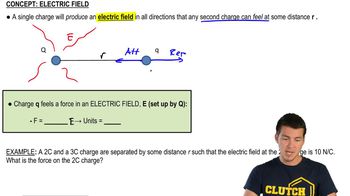
Electric Field

The electric field is a vector field that represents the force per unit charge experienced by a positive test charge placed in the field. It is measured in volts per meter (V/m) or millivolts per meter (mV/m). In this context, the electric field indicates how the electric potential changes along the length of the copper wire.
Video consigliato:
Percorso guidato
03:16
Intro to Electric Fields

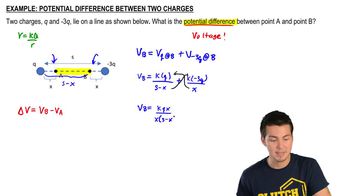
Potential Difference

Potential difference, also known as voltage, is the work done per unit charge in moving a charge between two points in an electric field. It is measured in volts (V). The potential difference across the ends of the wire can be calculated by multiplying the electric field by the length of the wire, providing insight into how much energy is available to move charges through the wire.
Video consigliato:
Percorso guidato
07:04
Potential Difference Between Two Charges

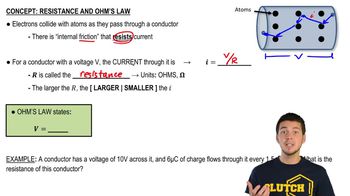
Ohm's Law

Ohm's Law states that the current flowing through a conductor between two points is directly proportional to the voltage across the two points and inversely proportional to the resistance of the conductor. While not directly needed to find the potential difference in this question, understanding Ohm's Law helps contextualize the relationship between electric field, potential difference, and current in conductive materials.
Video consigliato:
Percorso guidato
03:07
Resistance and Ohm's Law