
Ch 27: Current and Resistance
Knight Calc - Physics for Scientists and Engineers 5th Edition
Knight Calc5th EditionPhysics for Scientists and EngineersISBN: 9780137344796Non è quello che usi tu?Cambia libro di testo
Capitolo 27, Problema 58a

The total amount of charge in coulombs that has entered a wire at time t is given by the expression Q=4t−t2, where t is in seconds and t≥0. Find an expression for the current in the wire at time .

Guida verificata passo dopo passo
1
The relationship between current (I) and charge (Q) is given by the formula: I=dQdt. This means the current is the time derivative of the charge.
The given expression for charge is Q=4t-t2. To find the current, differentiate this expression with respect to time (t).
Apply the power rule of differentiation to each term in the expression for Q. For the first term, 4t, the derivative is 4. For the second term, t2, the derivative is 2t.
Combine the results of the differentiation. The derivative of Q with respect to t is: I=4-2t.
Thus, the expression for the current in the wire at time t is I=4-2t. This expression can now be used to calculate the current at any specific time t, provided t ≥ 0.

Risposta video verificata per un problema simile:

Questa soluzione video è stata consigliata dai nostri tutor come utile per risolvere questo problema.

Concetti chiave

Ecco i concetti essenziali che devi comprendere per rispondere correttamente alla domanda.

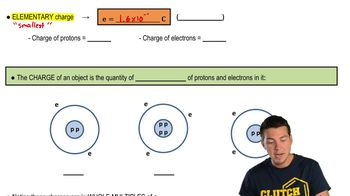
Electric Charge

Electric charge is a fundamental property of matter that causes it to experience a force when placed in an electromagnetic field. It is measured in coulombs (C) and can be positive or negative. In the context of the question, the total charge Q in the wire is expressed as a function of time, indicating how charge accumulates over time.
Video consigliato:
Percorso guidato
05:37
Electric Charge

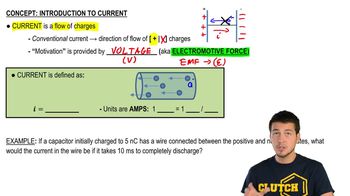
Current

Electric current is the rate at which electric charge flows through a conductor, typically measured in amperes (A). It can be calculated as the derivative of charge with respect to time, I = dQ/dt. Understanding how to derive the current from the charge function is essential for solving the problem presented.
Video consigliato:
Percorso guidato
05:38
Intro to Current

Differentiation

Differentiation is a mathematical process used to find the rate at which a quantity changes. In physics, it is often used to derive relationships between variables, such as finding current from charge. In this case, applying differentiation to the charge function Q = 4t - t² will yield the expression for current as a function of time.
Video consigliato:
Percorso guidato
13:04
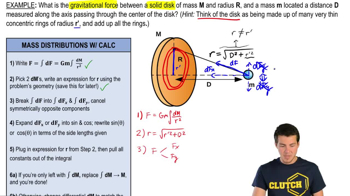
Gravitational Force from a Solid Disk
Pratica correlata
Domanda del libro di testo

The resistivity of a metal increases slightly with increased temperature. This can be expressed as ρ=ρ₀[1+α(T−T₀)] , where T₀ is a reference temperature, usually 20°C, and α is the temperature coefficient of resistivity. For copper, α=3.9×10⁻³ °C−1. Suppose a 2.5-m-long, 0.40-mm-diameter copper wire is connected across the terminals of a 1.5 V ideal battery. What is the current in the wire at 20°C?

149
views
Domanda del libro di testo

You need to design a 1.0 A fuse that 'blows' if the current exceeds 1.0 A. The fuse material in your stockroom melts at a current density of 500 A/cm2. What diameter wire of this material will do the job?

65
views
Domanda del libro di testo

The total amount of charge in coulombs that has entered a wire at time t is given by the expression Q=4t−t2, where t is in seconds and t≥0. Graph I versus t for the interval 0≤t≤4 s.

102
views
Domanda del libro di testo

A hollow metal cylinder has inner radius a, outer radius b, length L, and conductivity σ. The current I is radially outward from the inner surface to the outer surface. Evaluate the electric field strength at the inner and outer surfaces of an iron cylinder if a=1.0 cm, b=2.5 cm, L=10 cm, and I=25 A.

135
views
Domanda del libro di testo

The current supplied by a battery slowly decreases as the battery runs down. Suppose that the current as a function of time is I=(0.75A)e−t6hI=\(\left\)(0.75A\(\right\))e^{-\(\frac{t}{6h}\)}. What is the total number of electrons transported from the positive electrode to the negative electrode by the charge escalator from the time the battery is first used until it is completely dead?

193
views
Domanda del libro di testo

The total amount of charge that has entered a wire at time t is given by the expression Q=(20C)(1−e−t2.0s)Q=\(\left\)(20C\(\right\))\(\left\)(1-e^{-\(\frac{t}{2.0s}\)}\(\right\)), where t is in seconds and t≥0. What is the maximum value of the current?

83
views