
Ch 27: Current and Resistance
Knight Calc - Physics for Scientists and Engineers 5th Edition
Knight Calc5th EditionPhysics for Scientists and EngineersISBN: 9780137344796Non è quello che usi tu?Cambia libro di testo
Capitolo 27, Problema 59b

The total amount of charge that has entered a wire at time t is given by the expression Q=(20C)(1−e−t2.0s)Q=\(\left\)(20C\(\right\))\(\left\)(1-e^{-\(\frac{t}{2.0s}\)}\(\right\)), where t is in seconds and t≥0. What is the maximum value of the current?

Guida verificata passo dopo passo
1
The current, I, is the rate of change of charge, Q, with respect to time, t. Mathematically, this is expressed as I = dQ/dt. Start by differentiating the given expression for Q with respect to t.
The given expression for Q is Q = (20C)(1 - e^(-t/2.0s)). Use the chain rule to differentiate this expression. The derivative of a constant (20C) multiplied by a function is the constant multiplied by the derivative of the function.
The derivative of (1 - e^(-t/2.0s)) is 0 - (-1)(e^(-t/2.0s))(1/2.0s), where the factor (1/2.0s) comes from the chain rule applied to the exponent -t/2.0s. Simplify this derivative.
Combine the results to find the expression for the current: I = (20C)(e^(-t/2.0s))(1/2.0s). Simplify further to get I = (10C/s)(e^(-t/2.0s)).
To find the maximum value of the current, note that the exponential term e^(-t/2.0s) decreases as t increases. The maximum value of the current occurs at t = 0. Substitute t = 0 into the expression for I to determine the maximum current.

Risposta video verificata per un problema simile:

Questa soluzione video è stata consigliata dai nostri tutor come utile per risolvere questo problema.

Concetti chiave

Ecco i concetti essenziali che devi comprendere per rispondere correttamente alla domanda.

Charge (Q)

Charge is a fundamental property of matter that causes it to experience a force when placed in an electromagnetic field. In this context, the total charge Q that has entered the wire is expressed as a function of time t, indicating how charge accumulates over time. The equation provided shows that charge approaches a maximum value as time increases, reflecting the behavior of a charging capacitor.
Video consigliato:
Percorso guidato
05:43
Conservation of Charge

Current (I)

Current is defined as the rate of flow of electric charge through a conductor, typically measured in amperes (A). It can be calculated as the derivative of charge with respect to time (I = dQ/dt). In this scenario, understanding how to derive the current from the given charge function is essential to determine its maximum value as the system reaches steady state.
Video consigliato:
Percorso guidato
05:38
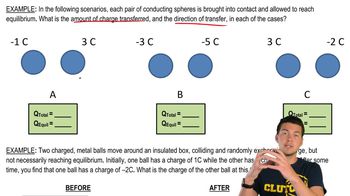
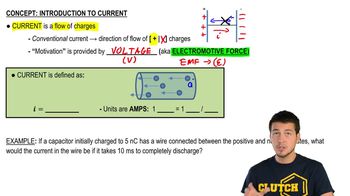
Intro to Current

Exponential Decay

Exponential decay describes a process where a quantity decreases at a rate proportional to its current value. In the given equation, the term involving 'e' represents this decay, indicating how the charge approaches its maximum value over time. This concept is crucial for understanding how quickly the current reaches its peak as the charge accumulates in the wire.
Video consigliato:
Percorso guidato
04:24
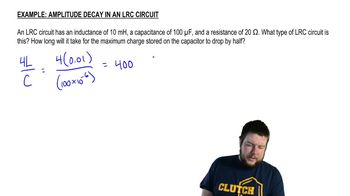
Amplitude Decay in an LRC Circuit
Pratica correlata
Domanda del libro di testo

The resistivity of a metal increases slightly with increased temperature. This can be expressed as ρ=ρ₀[1+α(T−T₀)] , where T₀ is a reference temperature, usually 20°C, and α is the temperature coefficient of resistivity. For copper, α=3.9×10⁻³ °C−1. Suppose a 2.5-m-long, 0.40-mm-diameter copper wire is connected across the terminals of a 1.5 V ideal battery. What is the current in the wire at 20°C?

149
views
Domanda del libro di testo

The total amount of charge in coulombs that has entered a wire at time t is given by the expression Q=4t−t2, where t is in seconds and t≥0. Graph I versus t for the interval 0≤t≤4 s.

102
views
Domanda del libro di testo

The total amount of charge in coulombs that has entered a wire at time t is given by the expression Q=4t−t2, where t is in seconds and t≥0. Find an expression for the current in the wire at time .

98
views
Domanda del libro di testo

The current supplied by a battery slowly decreases as the battery runs down. Suppose that the current as a function of time is I=(0.75A)e−t6hI=\(\left\)(0.75A\(\right\))e^{-\(\frac{t}{6h}\)}. What is the total number of electrons transported from the positive electrode to the negative electrode by the charge escalator from the time the battery is first used until it is completely dead?

193
views
Domanda del libro di testo

What diameter should the nichrome wire in FIGURE P27.62 be in order for the electric field strength to be the same in both wires?

174
views
Domanda del libro di testo

The two wires in FIGURE P27.63 are made of the same material. What is the electron drift speed in the 2.0-mm-diameter segment of the wire?

1631
views