Ch 27: Current and Resistance
Knight Calc - Physics for Scientists and Engineers 5th Edition
Knight Calc5th EditionPhysics for Scientists and EngineersISBN: 9780137344796Non è quello che usi tu?Cambia libro di testo
Capitolo 27, Problema 62

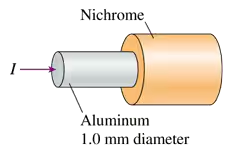
What diameter should the nichrome wire in FIGURE P27.62 be in order for the electric field strength to be the same in both wires?
Illustration of nichrome and aluminum wires, highlighting the aluminum wire's 1.0 mm diameter for electric field comparison.

Guida verificata passo dopo passo
1
Step 1: Understand the problem. The goal is to find the diameter of the nichrome wire such that the electric field strength in both wires is the same. Electric field strength in a wire is given by E = ρ * J, where ρ is the resistivity of the material and J is the current density.
Step 2: Relate the current density to the wire's cross-sectional area. Current density J is defined as J = I / A, where I is the current and A is the cross-sectional area of the wire. For a cylindrical wire, A = π * (d/2)^2, where d is the diameter of the wire.
Step 3: Set up the condition for equal electric field strength. Since E = ρ * J, and we want the electric field strength to be the same in both wires, we can write ρ_aluminum * J_aluminum = ρ_nichrome * J_nichrome.
Step 4: Substitute the expressions for current density into the equation. Using J = I / A, the equation becomes ρ_aluminum * (I / A_aluminum) = ρ_nichrome * (I / A_nichrome). Cancel out the current I, as it is the same in both wires.
Step 5: Solve for the diameter of the nichrome wire. Substitute A_aluminum = π * (d_aluminum/2)^2 and A_nichrome = π * (d_nichrome/2)^2 into the equation. Use the given diameter of the aluminum wire (1.0 mm) and the resistivities of aluminum and nichrome to find the diameter of the nichrome wire.

Risposta video verificata per un problema simile:

Questa soluzione video è stata consigliata dai nostri tutor come utile per risolvere questo problema.

Concetti chiave

Ecco i concetti essenziali che devi comprendere per rispondere correttamente alla domanda.

Electric Field Strength

Electric field strength is defined as the force per unit charge experienced by a positive test charge placed in the field. It is a vector quantity, represented by the symbol E, and is measured in volts per meter (V/m). Understanding electric field strength is crucial for analyzing how different materials respond to electric currents, particularly in comparing wires of different materials and diameters.
Video consigliato:
Percorso guidato
03:16
Intro to Electric Fields

Resistivity and Conductivity

Resistivity is a material property that quantifies how strongly a given material opposes the flow of electric current. It is denoted by the symbol ρ (rho) and is measured in ohm-meters (Ω·m). Conductivity, the inverse of resistivity, indicates how easily electricity can flow through a material. The relationship between resistivity, electric field strength, and current is essential for determining the appropriate diameter of the nichrome wire to match the electric field strength of the aluminum wire.
Video consigliato:

Current Density

Current density is defined as the amount of electric current flowing per unit area of a cross-section of a conductor. It is represented by the symbol J and is measured in amperes per square meter (A/m²). The current density is directly related to the electric field strength and the material's conductivity, which means that to achieve the same electric field strength in both wires, the current density must be equal, necessitating a specific diameter for the nichrome wire.
Video consigliato:
Percorso guidato
8:13
Intro to Density
Pratica correlata
Domanda del libro di testo

The total amount of charge in coulombs that has entered a wire at time t is given by the expression Q=4t−t2, where t is in seconds and t≥0. Graph I versus t for the interval 0≤t≤4 s.

102
views

Domanda del libro di testo

An aluminum wire consists of the three segments shown in FIGURE P27.64. The current in the top segment is 10 A. For each of these three segments, find the current density J. Place your results in a table for easy viewing.

1801
views
Domanda del libro di testo

The current supplied by a battery slowly decreases as the battery runs down. Suppose that the current as a function of time is I=(0.75A)e−t6hI=\(\left\)(0.75A\(\right\))e^{-\(\frac{t}{6h}\)}. What is the total number of electrons transported from the positive electrode to the negative electrode by the charge escalator from the time the battery is first used until it is completely dead?

193
views
Domanda del libro di testo

The total amount of charge that has entered a wire at time t is given by the expression Q=(20C)(1−e−t2.0s)Q=\(\left\)(20C\(\right\))\(\left\)(1-e^{-\(\frac{t}{2.0s}\)}\(\right\)), where t is in seconds and t≥0. What is the maximum value of the current?

83
views
Domanda del libro di testo

An aluminum wire consists of the three segments shown in FIGURE P27.64. The current in the top segment is 10 A. For each of these three segments, find the drift velocity vd. Place your results in a table for easy viewing.

125
views
Domanda del libro di testo

The two wires in FIGURE P27.63 are made of the same material. What is the electron drift speed in the 2.0-mm-diameter segment of the wire?

1631
views