
Ch 28: Fundamentals of Circuits
Knight Calc - Physics for Scientists and Engineers 5th Edition
Knight Calc5th EditionPhysics for Scientists and EngineersISBN: 9780137344796Non è quello che usi tu?Cambia libro di testo
Capitolo 28, Problema 69

A 150 μF defibrillator capacitor is charged to 1500 V. When fired through a patient’s chest, it loses 95% of its charge in 40 ms. What is the resistance of the patient’s chest?

Guida verificata passo dopo passo
1
Step 1: Recognize that the capacitor discharges through the patient's chest, which can be modeled as an RC circuit. The voltage across the capacitor during discharge follows the equation: Vt=V0⁢e-tτ, where τ is the time constant of the circuit.
Step 2: The time constant τ is given by the formula: τ=R⁢C, where R is the resistance and C is the capacitance.
Step 3: Use the information that the capacitor loses 95% of its charge in 40 ms. This means the voltage drops to 5% of its initial value. Substitute this into the discharge equation: Vt=V0⁢e-tτ, where Vt=0.05⁢V0 and t=40⁢ms.
Step 4: Solve for the time constant τ using the equation: e-tτ=0.05. Take the natural logarithm of both sides to isolate tτ: -tτ=ln(0.05). Rearrange to find τ: τ=t-ln(0.05).
Step 5: Once τ is calculated, use the formula τ=R⁢C to solve for the resistance R. Substitute the given capacitance C=150⁢μF and the calculated value of τ into the equation to find R.

Risposta video verificata per un problema simile:

Questa soluzione video è stata consigliata dai nostri tutor come utile per risolvere questo problema.

Concetti chiave

Ecco i concetti essenziali che devi comprendere per rispondere correttamente alla domanda.

Capacitance

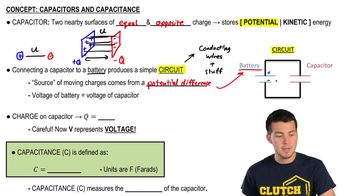
Capacitance is the ability of a capacitor to store electrical charge per unit voltage. It is measured in farads (F), and in this case, the defibrillator capacitor has a capacitance of 150 μF (microfarads). The charge (Q) stored in a capacitor can be calculated using the formula Q = C × V, where C is capacitance and V is voltage.
Video consigliato:
Percorso guidato
08:02
Capacitors & Capacitance (Intro)

Exponential Decay of Charge

When a capacitor discharges through a resistor, the charge decreases exponentially over time. The relationship is described by the equation Q(t) = Q0 * e^(-t/RC), where Q0 is the initial charge, R is resistance, and C is capacitance. In this scenario, the capacitor loses 95% of its charge in 40 ms, which can be used to find the resistance of the patient's chest.
Video consigliato:
Percorso guidato
04:24
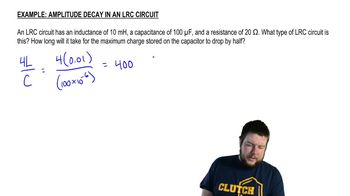
Amplitude Decay in an LRC Circuit

Ohm's Law

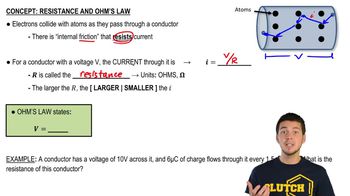
Ohm's Law relates voltage (V), current (I), and resistance (R) in an electrical circuit, expressed as V = I × R. In the context of the defibrillator, understanding this relationship is crucial for calculating the resistance of the patient's chest based on the current flowing through it as the capacitor discharges. This law helps in determining how the resistance affects the rate of charge loss.
Video consigliato:
Percorso guidato
03:07
Resistance and Ohm's Law
Pratica correlata