
Ch 28: Fundamentals of Circuits
Knight Calc - Physics for Scientists and Engineers 5th Edition
Knight Calc5th EditionPhysics for Scientists and EngineersISBN: 9780137344796Non è quello che usi tu?Cambia libro di testo
Capitolo 28, Problema 68

A circuit you’re using discharges a 20 μF capacitor through an unknown resistor. After charging the capacitor, you close a switch at t = 0 s and then monitor the resistor current with an ammeter. Your data are as follows: Use an appropriate graph of the data to determine (a) the resistance and (b) the initial capacitor voltage.

Guida verificata passo dopo passo
1
Step 1: Understand the problem. The capacitor discharges through a resistor, and the current decreases over time. This is a classic RC (resistor-capacitor) circuit problem. The current follows an exponential decay described by the equation: I=I0⁢e-t/τ, where τ=R⁢C is the time constant.
Step 2: Plot the data. Use the given current values and corresponding time values to create a graph. Plot the natural logarithm of the current (ln(I)) versus time (t). This will linearize the exponential decay equation, as ln(I)=ln(I0)-t/τ.
Step 3: Determine the slope of the linear graph. The slope of the graph (-1/τ) is related to the time constant τ. Use the slope to calculate the resistance R, knowing the capacitance C=20⁢μF. Rearrange the formula τ=R⁢C to solve for R: R=τ/C.
Step 4: Determine the initial capacitor voltage. The initial current I0 can be found from the y-intercept of the graph (ln(I0)). Use Ohm's law V0=I0⁢R to calculate the initial voltage across the capacitor.
Step 5: Verify your results. Ensure the calculated resistance and initial voltage are consistent with the data and the physical behavior of the RC circuit. Double-check the graph and calculations for accuracy.

Risposta video verificata per un problema simile:

Questa soluzione video è stata consigliata dai nostri tutor come utile per risolvere questo problema.

Concetti chiave

Ecco i concetti essenziali che devi comprendere per rispondere correttamente alla domanda.

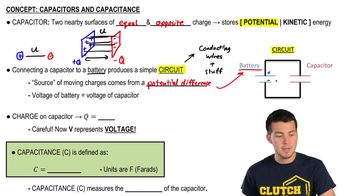
Capacitance

Capacitance is the ability of a capacitor to store electrical charge, measured in farads (F). A 20 μF capacitor can store a charge proportional to the voltage across it, following the relationship Q = C * V, where Q is charge, C is capacitance, and V is voltage. Understanding capacitance is crucial for analyzing how the capacitor discharges through the resistor over time.
Video consigliato:
Percorso guidato
08:02
Capacitors & Capacitance (Intro)

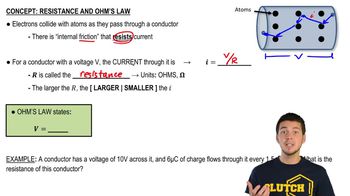
Ohm's Law

Ohm's Law states that the current (I) flowing through a conductor between two points is directly proportional to the voltage (V) across the two points and inversely proportional to the resistance (R) of the conductor, expressed as V = I * R. This fundamental principle is essential for determining the resistance in the circuit by analyzing the current and voltage data collected during the capacitor's discharge.
Video consigliato:
Percorso guidato
03:07
Resistance and Ohm's Law

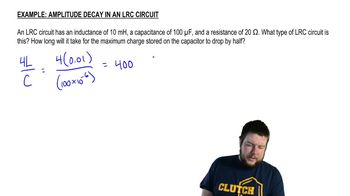
Exponential Decay in RC Circuits

In an RC (resistor-capacitor) circuit, the voltage across the capacitor and the current through the resistor decrease exponentially over time after the switch is closed. The voltage can be described by the equation V(t) = V0 * e^(-t/RC), where V0 is the initial voltage, R is resistance, and C is capacitance. This behavior is key to graphing the data and extracting both the resistance and the initial voltage of the capacitor.
Video consigliato:
Percorso guidato
04:24
Amplitude Decay in an LRC Circuit