Ch 28: Fundamentals of Circuits
Knight Calc - Physics for Scientists and Engineers 5th Edition
Knight Calc5th EditionPhysics for Scientists and EngineersISBN: 9780137344796Non è quello che usi tu?Cambia libro di testo
Capitolo 28, Problema 6b

Draw a graph of the potential as a function of the distance traveled through the circuit, traveling cw from V = 0 V at the lower left corner.

Guida verificata passo dopo passo
1
Identify the components of the circuit (e.g., resistors, batteries, capacitors) and their arrangement. Note the direction of current flow (clockwise, as stated in the problem) and the starting point where the potential is 0 V.
Understand that the potential difference across each component depends on its type: for a resistor, the potential drop is given by Ohm's Law \( V = IR \), where \( I \) is the current and \( R \) is the resistance; for a battery, the potential changes by the battery's emf (positive or negative depending on the direction of traversal).
Divide the circuit into segments based on the components encountered as you travel clockwise. For each segment, calculate the change in potential using the appropriate formula (e.g., \( \Delta V = -IR \) for a resistor if moving in the direction of current, or \( \Delta V = +\text{emf} \) for a battery if moving from negative to positive terminal).
Plot the potential as a function of distance traveled. Start at 0 V at the lower left corner and adjust the potential incrementally based on the calculated changes for each segment. Ensure the graph reflects the cumulative potential changes as you move through the circuit.
Label the graph axes appropriately: the x-axis represents the distance traveled through the circuit, and the y-axis represents the potential. Mark key points (e.g., where components are located) and ensure the graph is continuous and consistent with the circuit's configuration.

Risposta video verificata per un problema simile:

Questa soluzione video è stata consigliata dai nostri tutor come utile per risolvere questo problema.

Concetti chiave

Ecco i concetti essenziali che devi comprendere per rispondere correttamente alla domanda.

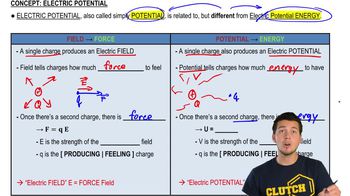
Electric Potential

Electric potential, often referred to as voltage, is the amount of electric potential energy per unit charge at a specific point in an electric field. It indicates how much work would be done to move a charge from a reference point (usually at infinity) to that point. Understanding electric potential is crucial for analyzing circuits, as it helps determine how charges will move and how energy is distributed throughout the circuit.
Video consigliato:
Percorso guidato
07:33
Electric Potential

Circuit Analysis

Circuit analysis involves the study of how electrical components are connected and how they interact within a circuit. This includes understanding the relationships between voltage, current, and resistance, often described by Ohm's Law. Analyzing circuits allows us to predict how changes in one part of the circuit will affect the overall behavior, including the potential at various points along the circuit.
Video consigliato:
Percorso guidato
05:00
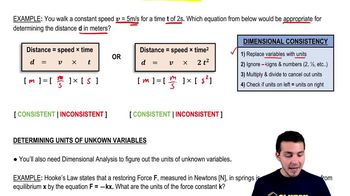
Dimensional Analysis

Graphing Functions

Graphing functions is a fundamental skill in physics and mathematics that involves plotting data points on a coordinate system to visualize relationships between variables. In the context of electric potential in a circuit, graphing the potential as a function of distance helps illustrate how voltage changes as one moves through the circuit. This visual representation aids in understanding the behavior of the circuit and the distribution of electric potential.
Video consigliato:
Percorso guidato
08:30
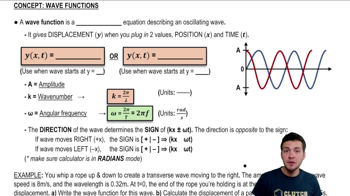
Intro to Wave Functions