Ch 29: The Magnetic Field
Knight Calc - Physics for Scientists and Engineers 5th Edition
Knight Calc5th EditionPhysics for Scientists and EngineersISBN: 9780137344796Non è quello che usi tu?Cambia libro di testo
Capitolo 29, Problema 56

A flat, circular disk of radius R is uniformly charged with total charge Q. The disk spins at angular velocity ω about an axis through its center. What is the magnetic field strength at the center of the disk?

Guida verificata passo dopo passo
1
Recognize that the spinning charged disk creates a current due to the motion of the charges. The magnetic field at the center of the disk can be calculated using the Biot-Savart law or Ampère's law, but first, we need to determine the equivalent current.
Divide the disk into infinitesimally small concentric rings of radius r and thickness dr. Each ring carries a charge dq, which contributes to the total charge Q of the disk.
The charge density (charge per unit area) of the disk is given by \( \sigma = \frac{Q}{\pi R^2} \). The charge of a ring at radius r is \( dq = \sigma \cdot 2\pi r \cdot dr \).
The current produced by the motion of the charges in the ring is \( dI = \omega \cdot dq \), where \( \omega \) is the angular velocity of the disk. Substituting \( dq \), we get \( dI = \omega \cdot \sigma \cdot 2\pi r \cdot dr \).
Integrate the contribution of the current from all the rings to find the total magnetic field at the center of the disk. Using the Biot-Savart law, the magnetic field at the center is \( B = \frac{\mu_0}{2} \cdot \omega \cdot \sigma \cdot R^2 \), where \( \mu_0 \) is the permeability of free space. This result comes from integrating the contributions of all the rings.

Risposta video verificata per un problema simile:

Questa soluzione video è stata consigliata dai nostri tutor come utile per risolvere questo problema.

Concetti chiave

Ecco i concetti essenziali che devi comprendere per rispondere correttamente alla domanda.

Magnetic Field Due to a Current

A magnetic field is generated by moving electric charges, which can be conceptualized as a current. In this case, the spinning charged disk creates a current loop, leading to a magnetic field at its center. The strength of this magnetic field can be calculated using the Biot-Savart law or Ampère's law, which relate the current and the resulting magnetic field.
Video consigliato:
Percorso guidato
12:33
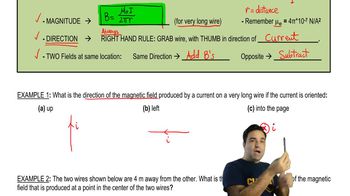
Magnetic Field Produced by Straight Currents

Angular Velocity

Angular velocity (ω) is a measure of how quickly an object rotates around an axis. It is defined as the rate of change of angular displacement and is typically measured in radians per second. In the context of the spinning disk, the angular velocity influences the effective current generated by the charge distribution, which in turn affects the magnetic field strength at the center.
Video consigliato:
Percorso guidato
06:18
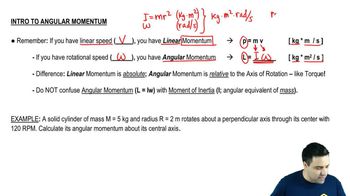
Intro to Angular Momentum

Charge Density

Charge density refers to the amount of charge per unit area on the disk's surface. For a uniformly charged disk, the surface charge density (σ) can be calculated by dividing the total charge (Q) by the area of the disk (πR²). This charge density is crucial for determining the current produced by the disk's rotation and ultimately influences the magnetic field strength at the center.
Video consigliato:
Percorso guidato
8:13
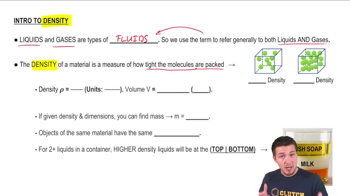
Intro to Density
Pratica correlata
Domanda del libro di testo

What is the magnetic field strength at the center of the semicircle in FIGURE P29.53?

339
views

Domanda del libro di testo

The heart produces a weak magnetic field that can be used to diagnose certain heart problems. It is a dipole field produced by a current loop in the outer layers of the heart. What is the magnitude of the heart's magnetic dipole moment?

418
views
Domanda del libro di testo

A long, hollow wire has inner radius R₁ and outer radius R₂. The wire carries current I uniformly distributed across the area of the wire. Use Ampère's law to find an expression for the magnetic field strength in the three regions 0 < r < R₁, R₁ < r < R₂, and R₂ < r.

248
views
Domanda del libro di testo

The toroid of FIGURE P29.54 is a coil of wire wrapped around a doughnut-shaped ring (a torus). Toroidal magnetic fields are used to confine fusion plasmas. Is a toroidal magnetic field a uniform field? Explain.

240
views
Domanda del libro di testo

A proton moving in a uniform magnetic field with v⃗1=(1.00×10⁶i^)m/s\(\vec{v}\)_1 = (1.00 \(\times\) 10^6\,\(\hat{i}\))\,\(\text{m/s}\) experiences force F⃗1=(1.20×10⁻¹⁶k^)N\(\vec{F}\)_1 = (1.20 \(\times\) 10^{-16}\,\(\hat{k}\))\,\(\text{N}\). A second proton with v⃗2=(2.0×10⁶j^)m/s\(\vec{v}\)_2 = (2.0 \(\times\) 10^6\,\(\hat{j}\))\,\(\text{m/s}\) experiences F⃗2=(−4.16×10⁻¹⁶k^)N\(\vec{F}\)_2 = (-4.16 \(\times\) 10^{-16}\,\(\hat{k}\))\,\(\text{N}\) in the same field. What is B⃗\(\vec{B}\)? Give your answer as a magnitude and an angle measured counter-clockwise from the +x+x-axis.

335
views
Domanda del libro di testo

An electron in a cathode-ray tube is accelerated through a potential difference of 10 kV, then passes through the 2.0-cm-wide region of uniform magnetic field in FIGURE P29.60. What field strength will deflect the electron by 10°?

426
views