Ch 29: The Magnetic Field
Knight Calc - Physics for Scientists and Engineers 5th Edition
Knight Calc5th EditionPhysics for Scientists and EngineersISBN: 9780137344796Non è quello che usi tu?Cambia libro di testo
Capitolo 29, Problema 54c

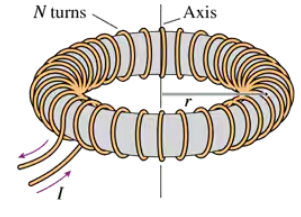
The toroid of FIGURE P29.54 is a coil of wire wrapped around a doughnut-shaped ring (a torus). Toroidal magnetic fields are used to confine fusion plasmas. Is a toroidal magnetic field a uniform field? Explain.

Guida verificata passo dopo passo
1
Step 1: Begin by understanding the structure of the toroid shown in the image. A toroid is a coil of wire wrapped around a doughnut-shaped ring (torus). The wire carries a current, denoted as 'I', and the toroid has 'N' turns of wire. The magnetic field is generated within the toroidal ring due to the current flowing through the wire.
Step 2: Recall Ampere's Law, which is used to calculate the magnetic field inside a toroid. Ampere's Law states: ∮𝐵⋅𝑑𝑙 = μ₀𝐼ₑ𝑛𝑐, where 𝐵 is the magnetic field, 𝑑𝑙 is the path length, μ₀ is the permeability of free space, and 𝐼ₑ𝑛𝑐 is the enclosed current. For a toroid, the magnetic field is confined within the ring and circulates along the circular path inside the torus.
Step 3: Analyze the uniformity of the magnetic field. The magnetic field inside a toroid depends on the radius 'r' of the circular path. The formula for the magnetic field inside a toroid is: 𝐵 = (μ₀𝑁𝐼)/(2π𝑟), where 𝑟 is the distance from the center of the toroid to the point of interest. This indicates that the magnetic field strength decreases as the radius increases.
Step 4: Consider the implications of the formula. Since the magnetic field strength varies with the radius 'r', the field is not uniform throughout the toroid. It is stronger closer to the inner radius and weaker near the outer radius of the toroidal ring.
Step 5: Conclude that a toroidal magnetic field is not a uniform field. The variation in the magnetic field strength with radius makes it non-uniform. However, the field is confined within the toroid and does not extend outside the ring, which is a key characteristic of toroidal magnetic fields.

Risposta video verificata per un problema simile:

Questa soluzione video è stata consigliata dai nostri tutor come utile per risolvere questo problema.

Concetti chiave

Ecco i concetti essenziali che devi comprendere per rispondere correttamente alla domanda.

Toroidal Magnetic Field

A toroidal magnetic field is generated by a current flowing through a wire wound in a circular shape, forming a doughnut-like structure. The magnetic field lines are confined within the torus, creating a closed loop. This configuration is particularly useful in applications like magnetic confinement in fusion reactors, as it helps to contain plasma effectively.
Video consigliato:
Percorso guidato
11:47
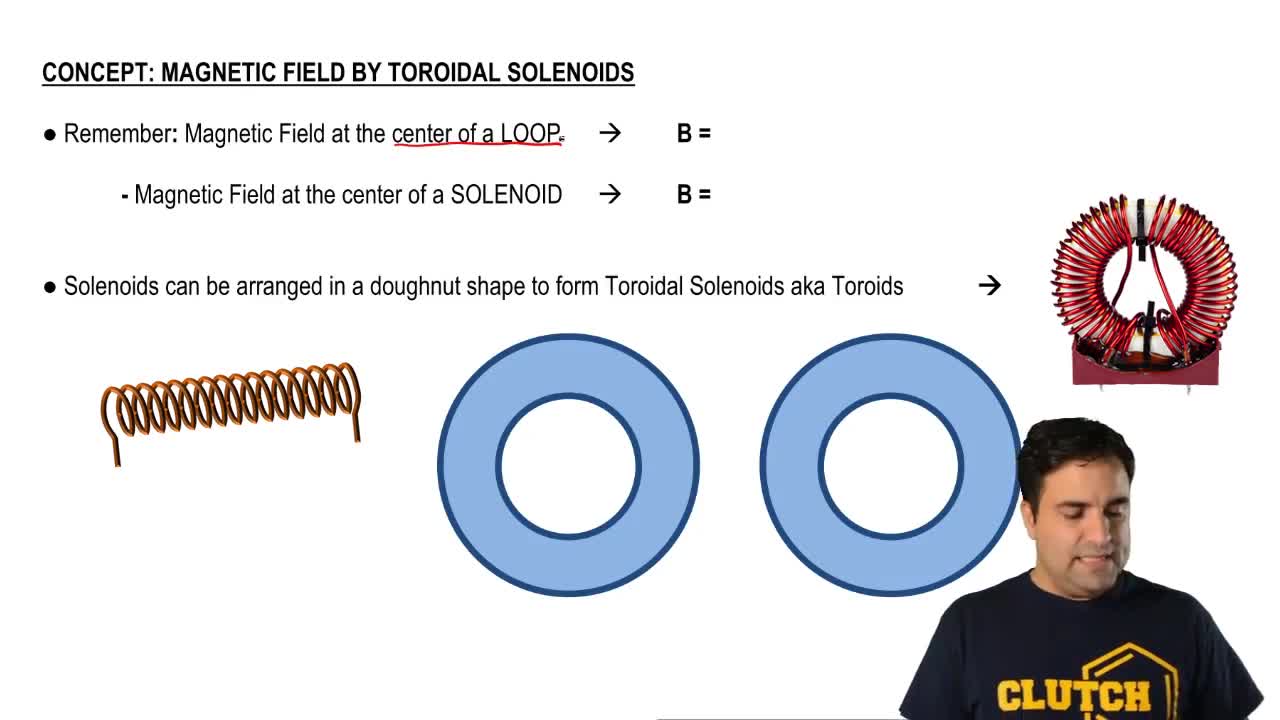
Toroidal Solenoids aka Toroids

Uniform Magnetic Field

A uniform magnetic field is one where the magnetic field strength and direction are constant throughout a given region. In contrast, a non-uniform field varies in strength and direction at different points. Understanding whether a toroidal magnetic field is uniform involves analyzing how the field strength changes with distance from the center of the torus.
Video consigliato:
Percorso guidato
05:30
Magnetic Fields and Magnetic Dipoles

Magnetic Field Strength Variation

In a toroidal configuration, the magnetic field strength is not uniform; it varies with the radial distance from the center of the torus. The field is strongest near the center and decreases as one moves outward. This variation is crucial for applications in plasma confinement, as it affects the stability and behavior of the plasma within the toroidal magnetic field.
Video consigliato:
Percorso guidato
05:30
Magnetic Fields and Magnetic Dipoles
Pratica correlata
Domanda del libro di testo

What is the magnetic field strength at the center of the semicircle in FIGURE P29.53?

339
views

Domanda del libro di testo

The heart produces a weak magnetic field that can be used to diagnose certain heart problems. It is a dipole field produced by a current loop in the outer layers of the heart. What is the magnitude of the heart's magnetic dipole moment?

418
views
Domanda del libro di testo

A long, hollow wire has inner radius R₁ and outer radius R₂. The wire carries current I uniformly distributed across the area of the wire. Use Ampère's law to find an expression for the magnetic field strength in the three regions 0 < r < R₁, R₁ < r < R₂, and R₂ < r.

248
views
Domanda del libro di testo

The earth's magnetic field, with a magnetic dipole moment of 8.0 x 10²² A m2, is generated by currents within the molten iron of the earth's outer core. Suppose we model the core current as a 3000-km-diameter current loop made from a 1000-km-diameter 'wire.' The loop diameter is measured from the centers of this very fat wire. What is the current density J in the current loop?

114
views
Domanda del libro di testo

A proton moving in a uniform magnetic field with v⃗1=(1.00×10⁶i^)m/s\(\vec{v}\)_1 = (1.00 \(\times\) 10^6\,\(\hat{i}\))\,\(\text{m/s}\) experiences force F⃗1=(1.20×10⁻¹⁶k^)N\(\vec{F}\)_1 = (1.20 \(\times\) 10^{-16}\,\(\hat{k}\))\,\(\text{N}\). A second proton with v⃗2=(2.0×10⁶j^)m/s\(\vec{v}\)_2 = (2.0 \(\times\) 10^6\,\(\hat{j}\))\,\(\text{m/s}\) experiences F⃗2=(−4.16×10⁻¹⁶k^)N\(\vec{F}\)_2 = (-4.16 \(\times\) 10^{-16}\,\(\hat{k}\))\,\(\text{N}\) in the same field. What is B⃗\(\vec{B}\)? Give your answer as a magnitude and an angle measured counter-clockwise from the +x+x-axis.

335
views
Domanda del libro di testo

A flat, circular disk of radius R is uniformly charged with total charge Q. The disk spins at angular velocity ω about an axis through its center. What is the magnetic field strength at the center of the disk?

224
views