Ch 29: The Magnetic Field
Knight Calc - Physics for Scientists and Engineers 5th Edition
Knight Calc5th EditionPhysics for Scientists and EngineersISBN: 9780137344796Non è quello che usi tu?Cambia libro di testo
Capitolo 29, Problema 3

A proton moves along the x-axis with vₓ = 1.0 x 10⁷ m/s. As it passes the origin, what are the strength and direction of the magnetic field at the (x, y, z) positions (a) (1 cm, 0 cm, 0 cm), (b) (0 cm, 1 cm, 0 cm), and (c) (0 cm, -2 cm, 0 cm)?

Guida verificata passo dopo passo
1
Step 1: Recall the formula for the magnetic field produced by a moving charge. The magnetic field at a point due to a moving charge is given by **B = (μ₀ / 4π) * (q * v × r̂) / r²**, where μ₀ is the permeability of free space, q is the charge, v is the velocity vector, r̂ is the unit vector pointing from the charge to the observation point, and r is the distance between the charge and the observation point.
Step 2: Identify the given values. The charge of a proton is q = 1.6 × 10⁻¹⁹ C, the velocity vector is **v = (1.0 × 10⁷ m/s) î**, and the observation points are (a) (1 cm, 0 cm, 0 cm), (b) (0 cm, 1 cm, 0 cm), and (c) (0 cm, -2 cm, 0 cm). Convert the distances to meters: 1 cm = 0.01 m, 2 cm = 0.02 m.
Step 3: For each observation point, calculate the distance vector **r** and the unit vector **r̂**. For example, for point (a), **r = (0.01 m) î**, and **r̂ = r / |r| = î**. Similarly, calculate **r** and **r̂** for points (b) and (c).
Step 4: Compute the cross product **v × r̂** for each observation point. For point (a), since **v** and **r̂** are parallel, the cross product is zero, meaning the magnetic field at (1 cm, 0 cm, 0 cm) is zero. For points (b) and (c), use the right-hand rule to determine the direction of **v × r̂** and calculate its magnitude.
Step 5: Substitute the values into the formula for **B** to find the magnitude and direction of the magnetic field at each point. Use the calculated **v × r̂**, the distance **r**, and the constants μ₀ = 4π × 10⁻⁷ T·m/A and q = 1.6 × 10⁻¹⁹ C to determine the magnetic field strength at points (b) and (c).

Risposta video verificata per un problema simile:

Questa soluzione video è stata consigliata dai nostri tutor come utile per risolvere questo problema.
Durata del video:
6m

Concetti chiave

Ecco i concetti essenziali che devi comprendere per rispondere correttamente alla domanda.

Magnetic Field Due to a Moving Charge

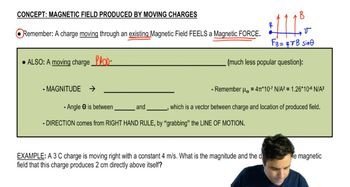
A moving charge, such as a proton, generates a magnetic field around it. The strength and direction of this magnetic field can be determined using the right-hand rule and the Biot-Savart law, which relates the magnetic field to the velocity of the charge and its distance from the point of interest.
Video consigliato:
Percorso guidato
10:47
Magnetic Field Produced by Moving Charges

Right-Hand Rule

The right-hand rule is a mnemonic used to determine the direction of the magnetic field produced by a moving charge. By pointing the thumb of the right hand in the direction of the charge's velocity and curling the fingers, the direction of the magnetic field lines can be found, which are perpendicular to both the velocity and the direction of the magnetic field.
Video consigliato:
Percorso guidato
19:11
Force on Moving Charges & Right Hand Rule

Coordinate System and Position Vectors

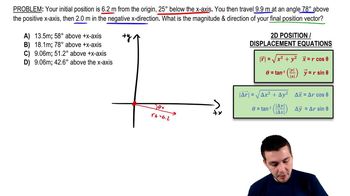
In physics, a coordinate system is used to define the position of points in space. The positions given in the question (e.g., (1 cm, 0 cm, 0 cm)) represent points in a three-dimensional Cartesian coordinate system, where the x, y, and z coordinates indicate the location in space relative to the origin. Understanding this system is crucial for calculating the magnetic field at specific points.
Video consigliato:
Percorso guidato
07:07
Final Position Vector