

Ch 29: The Magnetic Field
Knight Calc - Physics for Scientists and Engineers 5th Edition
Knight Calc5th EditionPhysics for Scientists and EngineersISBN: 9780137344796Non è quello che usi tu?Cambia libro di testo
Capitolo 29, Problema 83b

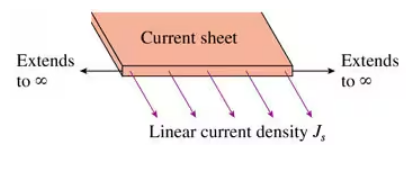
An infinitely wide flat sheet of charge flows out of the figure in FIGURE CP29.83. The current per unit width along the sheet (amps per meter) is given by the linear current density Js. Find the magnetic field strength at distance d above or below the current sheet.

Guida verificata passo dopo passo
1
Step 1: Recognize that the problem involves calculating the magnetic field due to an infinitely wide current sheet. The current sheet has a linear current density Js (current per unit width), and we need to find the magnetic field at a distance d above or below the sheet.
Step 2: Use Ampere's Law, which states that the line integral of the magnetic field around a closed loop is equal to μ₀ times the current enclosed by the loop. The formula is: ∮B⋅dl = μ₀I_enclosed.
Step 3: Choose an appropriate Amperian loop. For this problem, a rectangular loop is ideal, with one side parallel to the current sheet above it at distance d, and the other side parallel to the sheet below it at distance d. The other two sides of the loop are perpendicular to the sheet.
Step 4: Analyze the symmetry of the problem. The magnetic field will be uniform and parallel to the current sheet at distances d above and below the sheet. The contributions to the integral from the sides perpendicular to the sheet cancel out due to symmetry.
Step 5: Solve for the magnetic field strength. The total current enclosed by the Amperian loop is Js (linear current density) multiplied by the width of the loop. Using Ampere's Law, the magnetic field strength B at distance d is given by: B = (μ₀Js)/2, where μ₀ is the permeability of free space. The factor of 1/2 arises because the field splits equally above and below the sheet.

Risposta video verificata per un problema simile:

Questa soluzione video è stata consigliata dai nostri tutor come utile per risolvere questo problema.

Concetti chiave

Ecco i concetti essenziali che devi comprendere per rispondere correttamente alla domanda.

Linear Current Density (Js)

Linear current density, denoted as Js, represents the amount of electric current flowing per unit width of a current-carrying conductor. It is measured in amperes per meter (A/m) and is crucial for understanding how current is distributed across a surface. In the context of a current sheet, Js helps determine the magnetic field generated by the current flowing through the sheet.
Video consigliato:
Percorso guidato
8:13
Intro to Density

Magnetic Field Due to Current

The magnetic field generated by a current-carrying conductor can be described by Ampère's Law, which relates the magnetic field around a conductor to the current flowing through it. For an infinitely wide current sheet, the magnetic field strength is uniform and perpendicular to the direction of the current. This concept is essential for calculating the magnetic field strength at a distance from the current sheet.
Video consigliato:
Percorso guidato
12:33
Magnetic Field Produced by Straight Currents

Biot-Savart Law

The Biot-Savart Law provides a method to calculate the magnetic field produced by a small segment of current-carrying wire. It states that the magnetic field at a point in space is proportional to the current, the length of the wire segment, and the sine of the angle between the wire and the line connecting the wire to the point. This law is foundational for understanding how current distributions, like those in a current sheet, generate magnetic fields.
Video consigliato:
Percorso guidato
04:53
Biot-Savart Law with Calculus