Ch 29: The Magnetic Field
Knight Calc - Physics for Scientists and Engineers 5th Edition
Knight Calc5th EditionPhysics for Scientists and EngineersISBN: 9780137344796Non è quello che usi tu?Cambia libro di testo
Capitolo 29, Problema 39b

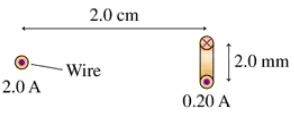
What is the loop's equilibrium orientation?

Guida verificata passo dopo passo
1
Understand the context of the problem: The equilibrium orientation of a loop typically refers to the position where the net torque acting on the loop is zero. This often involves analyzing the interaction between the magnetic field and the current-carrying loop.
Identify the forces and torques acting on the loop: A current-carrying loop in a magnetic field experiences a torque due to the interaction between the magnetic moment of the loop and the magnetic field. The torque is given by the vector equation: τ = μ × B, where μ is the magnetic moment of the loop and B is the magnetic field.
Determine the magnetic moment of the loop: The magnetic moment μ is calculated as μ = I A, where I is the current in the loop and A is the area vector of the loop. The direction of A is determined by the right-hand rule.
Set the condition for equilibrium: For the loop to be in equilibrium, the torque must be zero. This happens when the magnetic moment μ is aligned with the magnetic field B. Mathematically, this means the angle θ between μ and B is zero (parallel) or 180 degrees (antiparallel).
Conclude the equilibrium orientation: The loop's equilibrium orientation is when its plane is perpendicular to the magnetic field, and the magnetic moment vector is either aligned (parallel) or anti-aligned (antiparallel) with the magnetic field direction.

Risposta video verificata per un problema simile:

Questa soluzione video è stata consigliata dai nostri tutor come utile per risolvere questo problema.
Durata del video:
4m

Concetti chiave

Ecco i concetti essenziali che devi comprendere per rispondere correttamente alla domanda.

Equilibrium

Equilibrium in physics refers to a state where all forces and torques acting on an object are balanced, resulting in no net force or rotation. In the context of a loop, this means that the gravitational force, tension, and any other forces are in balance, allowing the loop to maintain a stable position without accelerating or rotating.
Video consigliato:
Percorso guidato
10:13
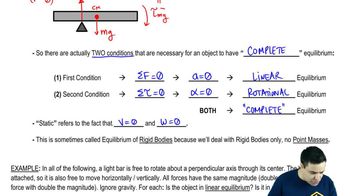
Torque & Equilibrium

Torque

Torque is a measure of the rotational force applied to an object, which causes it to rotate around an axis. The equilibrium orientation of a loop is influenced by the torques generated by various forces acting on it, such as gravity and tension. For the loop to be in equilibrium, the sum of the torques must equal zero.
Video consigliato:
Percorso guidato
08:55
Net Torque & Sign of Torque

Center of Mass

The center of mass is the point in an object where its mass is evenly distributed in all directions. For a loop, the center of mass plays a crucial role in determining its equilibrium orientation, as the loop will tend to orient itself such that the center of mass is at the lowest possible point, minimizing potential energy and achieving stability.
Video consigliato:
Percorso guidato
06:30
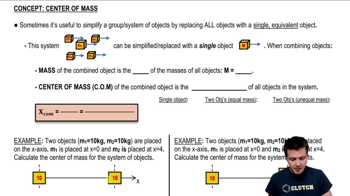
Intro to Center of Mass
Pratica correlata
Domanda del libro di testo

A small bar magnet experiences a 0.020 N m torque when the axis of the magnet is at 45° to a 0.10 T magnetic field. What is the magnitude of its magnetic dipole moment?

441
views

Domanda del libro di testo

A long wire carrying a 5.0 A current perpendicular to the xy-plane intersects the x-axis at x = -2.0 cm. A second, parallel wire carrying a 3.0 A current intersects the x-axis at x = +2.0 cm. At what point or points on the x-axis is the magnetic field zero if (a) the two currents are in the same direction and (b) the two currents are in opposite directions?

172
views
Domanda del libro di testo

What is the magnitude of the torque on the current loop in FIGURE EX29.39?

656
views
Domanda del libro di testo

The two 10-cm-long parallel wires in FIGURE EX29.33 are separated by 5.0 mm. For what value of the resistor R will the force between the two wires be 5.4 x 10⁻⁵ N?

2054
views
1
rank
Domanda del libro di testo

FIGURE EX29.37 is a cross section through three long wires with linear mass density 50 g/m. They each carry equal currents in the directions shown. The lower two wires are 4.0 cm apart and are attached to a table. What current I will allow the upper wire to 'float' so as to form an equilateral triangle with the lower wires?

2375
views
Domanda del libro di testo

When seen from the end, three long, parallel wires form an equilateral triangle 6.0 cm on a side. The wires each carry a 5.0 A current, with one current direction opposite the other two. What is the magnetic field strength at the center of the triangle?

151
views