A small bar magnet experiences a 0.020 N m torque when the axis of the magnet is at 45° to a 0.10 T magnetic field. What is the magnitude of its magnetic dipole moment?
Ch 29: The Magnetic Field
Knight Calc5th EditionPhysics for Scientists and EngineersISBN: 9780137344796Non è quello che usi tu?Cambia libro di testo
Capitolo 29, Problema 37
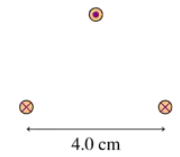
FIGURE EX29.37 is a cross section through three long wires with linear mass density 50 g/m. They each carry equal currents in the directions shown. The lower two wires are 4.0 cm apart and are attached to a table. What current I will allow the upper wire to 'float' so as to form an equilateral triangle with the lower wires?

Guida verificata passo dopo passo1
Understand the problem: The goal is to determine the current \( I \) in the upper wire such that it 'floats' in equilibrium, forming an equilateral triangle with the two lower wires. This means the net force on the upper wire due to the magnetic forces from the lower wires and its weight must be zero.
Step 1: Recall the formula for the magnetic force per unit length between two parallel current-carrying wires. The force per unit length is given by \( F/L = \frac{\mu_0 I_1 I_2}{2 \pi d} \), where \( \mu_0 \) is the permeability of free space, \( I_1 \) and \( I_2 \) are the currents in the wires, and \( d \) is the distance between the wires.
Step 2: Analyze the forces acting on the upper wire. The magnetic forces from the two lower wires will act at an angle of 60° to each other (since the wires form an equilateral triangle). The weight of the upper wire, \( F_g = \lambda g \), where \( \lambda \) is the linear mass density and \( g \) is the acceleration due to gravity, acts vertically downward.
Step 3: Resolve the magnetic forces into components. The horizontal components of the magnetic forces from the two lower wires will cancel out due to symmetry. The vertical components will add up to balance the weight of the upper wire. Use trigonometry to express the vertical component of the magnetic force: \( F_{vertical} = 2 \cdot F_{magnetic} \cdot \sin(60°) \).
Step 4: Set up the equilibrium condition. For the upper wire to float, the total upward magnetic force must equal the downward gravitational force: \( 2 \cdot \frac{\mu_0 I^2}{2 \pi d} \cdot \sin(60°) = \lambda g \). Solve this equation for \( I \), the current in the wires.

Risposta video verificata per un problema simile:
Questa soluzione video è stata consigliata dai nostri tutor come utile per risolvere questo problema.
Durata del video:
13mConcetti chiave
Ecco i concetti essenziali che devi comprendere per rispondere correttamente alla domanda.
Magnetic Force Between Current-Carrying Wires
When two parallel wires carry electric currents, they exert magnetic forces on each other. The direction of the force depends on the direction of the currents: if the currents are in the same direction, the wires attract; if they are in opposite directions, they repel. This principle is crucial for understanding how the upper wire can 'float' in equilibrium between the lower wires.
Video consigliato:
Percorso guidato
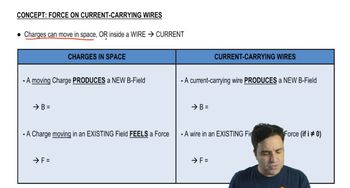
Magnetic Force on Current-Carrying Wire
Equilibrium of Forces
For the upper wire to float and form an equilateral triangle with the lower wires, the net force acting on it must be zero. This means that the magnetic forces exerted by the lower wires on the upper wire must balance out. Analyzing the forces involved allows us to determine the required current in the upper wire to achieve this balance.
Video consigliato:
Percorso guidato
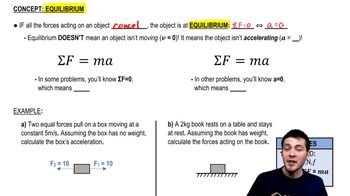
Equilibrium
Linear Mass Density and Weight
Linear mass density is defined as mass per unit length of an object, in this case, the wires. The weight of the upper wire, which acts downward due to gravity, is determined by its linear mass density and the length of the wire. This weight must be counteracted by the magnetic forces from the lower wires for the upper wire to remain suspended.
Video consigliato:
Percorso guidato
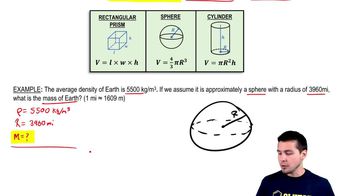
Problems with Mass, Volume, & Density
Pratica correlata
Domanda del libro di testo
441
views
Domanda del libro di testo
What is the loop's equilibrium orientation?
1606
views
Domanda del libro di testo
What is the magnitude of the torque on the current loop in FIGURE EX29.39?
656
views
Domanda del libro di testo
The two 10-cm-long parallel wires in FIGURE EX29.33 are separated by 5.0 mm. For what value of the resistor R will the force between the two wires be 5.4 x 10⁻⁵ N?
2054
views
1
rank
Domanda del libro di testo
The microwaves in a microwave oven are produced in a special tube called a magnetron. The electrons orbit the magnetic field at 2.4 GHz, and as they do so they emit 2.4 GHz electromagnetic waves. What is the magnetic field strength?
309
views
Domanda del libro di testo
The Hall voltage across a conductor in a 55 mT magnetic field is 1.9 μV. When used with the same current in a different magnetic field, the voltage across the conductor is 2.8 μV. What is the strength of the second field?
108
views