Ch 29: The Magnetic Field
Knight Calc - Physics for Scientists and Engineers 5th Edition
Knight Calc5th EditionPhysics for Scientists and EngineersISBN: 9780137344796Non è quello che usi tu?Cambia libro di testo
Capitolo 29, Problema 17b

The on-axis magnetic field strength 10 cm from a small bar magnet is 500 μT. What is the on-axis field strength 15 cm from the magnet?

Guida verificata passo dopo passo
1
Step 1: Understand the relationship between the magnetic field strength and distance from the magnet. For a small bar magnet, the magnetic field strength on the axis decreases approximately as the cube of the distance from the magnet. This means the field strength is proportional to 1/(distance³).
Step 2: Write the formula for the magnetic field strength at a distance from the magnet: \( B \propto \frac{1}{r^3} \), where \( B \) is the magnetic field strength and \( r \) is the distance from the magnet.
Step 3: Set up the ratio of the magnetic field strengths at two distances using the proportionality: \( \frac{B_2}{B_1} = \left( \frac{r_1}{r_2} \right)^3 \), where \( B_1 \) and \( B_2 \) are the field strengths at distances \( r_1 \) and \( r_2 \), respectively.
Step 4: Substitute the given values into the ratio formula. Here, \( B_1 = 500 \, \mu T \), \( r_1 = 10 \, \text{cm} \), and \( r_2 = 15 \, \text{cm} \). The equation becomes \( B_2 = B_1 \cdot \left( \frac{r_1}{r_2} \right)^3 \).
Step 5: Simplify the expression to find \( B_2 \). Perform the cube of the ratio \( \left( \frac{10}{15} \right)^3 \) and multiply it by \( B_1 \). This will give the magnetic field strength at 15 cm from the magnet.

Risposta video verificata per un problema simile:

Questa soluzione video è stata consigliata dai nostri tutor come utile per risolvere questo problema.

Concetti chiave

Ecco i concetti essenziali che devi comprendere per rispondere correttamente alla domanda.

Magnetic Field Strength

Magnetic field strength, often denoted as B, is a measure of the magnetic force experienced by a unit magnetic pole in a magnetic field. It is typically measured in teslas (T) or microteslas (μT). The strength of the magnetic field decreases with distance from the magnet, following specific mathematical relationships depending on the type of magnet.
Video consigliato:
Percorso guidato
05:30
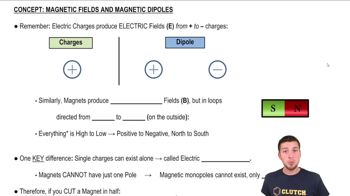
Magnetic Fields and Magnetic Dipoles

Inverse Square Law

The inverse square law states that the strength of a physical quantity (like gravitational or magnetic fields) decreases with the square of the distance from the source. For magnetic fields produced by dipoles, the field strength decreases as the distance increases, specifically following a 1/r^3 relationship for a bar magnet along its axis, where r is the distance from the magnet.
Video consigliato:
Percorso guidato
05:26
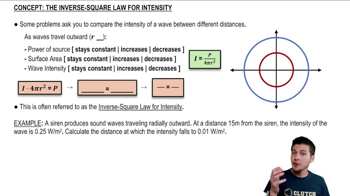
The Inverse-Square Law for Intensity

Bar Magnet Characteristics

A bar magnet has a north and south pole, creating a magnetic field that emanates from the north pole and returns to the south pole. The field strength is strongest at the poles and diminishes with distance. Understanding the geometry and field lines of a bar magnet is crucial for predicting how the magnetic field behaves at various distances.
Video consigliato:
Percorso guidato
05:30
Magnetic Fields and Magnetic Dipoles