
Ch 30: Electromagnetic Induction
Knight Calc - Physics for Scientists and Engineers 5th Edition
Knight Calc5th EditionPhysics for Scientists and EngineersISBN: 9780137344796Non è quello che usi tu?Cambia libro di testo
Capitolo 30, Problema 86b

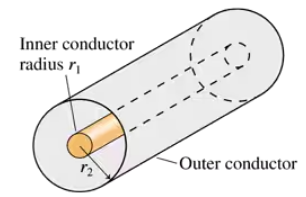
CALC High-frequency signals are often transmitted along a coaxial cable, such as the one shown in FIGURE CP30.86. For example, the cable TV hookup coming into your home is a coaxial cable. The signal is carried on a wire of radius r1 while the outer conductor of radius r2 is grounded. A soft, flexible insulating material fills the space between them, and an insulating plastic coating goes around the outside. Evaluate the inductance per meter of a cable having r1 = 0.50 mm and r2 = 3.0 mm.

Guida verificata passo dopo passo
1
Step 1: Understand the problem. The inductance per unit length of a coaxial cable can be calculated using the formula for inductance of a coaxial cable: \( L = \frac{\mu_0}{2\pi} \ln\left(\frac{r_2}{r_1}\right) \), where \( \mu_0 \) is the permeability of free space (\( \mu_0 = 4\pi \times 10^{-7} \ \text{H/m} \)), \( r_1 \) is the radius of the inner conductor, and \( r_2 \) is the radius of the outer conductor.
Step 2: Substitute the given values for \( r_1 \) and \( r_2 \) into the formula. The problem states \( r_1 = 0.50 \ \text{mm} = 0.50 \times 10^{-3} \ \text{m} \) and \( r_2 = 3.0 \ \text{mm} = 3.0 \times 10^{-3} \ \text{m} \).
Step 3: Calculate the natural logarithm term \( \ln\left(\frac{r_2}{r_1}\right) \). This involves dividing \( r_2 \) by \( r_1 \) and then taking the natural logarithm of the result.
Step 4: Multiply the result of the logarithm by \( \frac{\mu_0}{2\pi} \). Here, \( \mu_0 \) is \( 4\pi \times 10^{-7} \ \text{H/m} \), and \( 2\pi \) is a constant.
Step 5: The final result will give the inductance per meter of the coaxial cable. Ensure the units are consistent throughout the calculation, and the result will be in henries per meter (H/m).

Risposta video verificata per un problema simile:

Questa soluzione video è stata consigliata dai nostri tutor come utile per risolvere questo problema.
Durata del video:
12m

Concetti chiave

Ecco i concetti essenziali che devi comprendere per rispondere correttamente alla domanda.

Coaxial Cable Structure

A coaxial cable consists of an inner conductor and an outer conductor, separated by an insulating material. The inner conductor carries the signal, while the outer conductor serves as a ground and helps shield the signal from external interference. The radii of these conductors, denoted as r1 for the inner and r2 for the outer, are crucial for calculating various electrical properties, including inductance.
Video consigliato:
Percorso guidato
03:25
Multiple Cables on a Loudspeaker

Inductance

Inductance is a property of an electrical conductor that quantifies its ability to store energy in a magnetic field when an electric current flows through it. For coaxial cables, the inductance per unit length can be calculated using the radii of the inner and outer conductors. This property is essential for understanding how signals propagate through the cable and how they may be affected by frequency.
Video consigliato:
Percorso guidato
12:59
Mutual Induction

Electromagnetic Theory

Electromagnetic theory describes how electric and magnetic fields interact and propagate through space. In the context of coaxial cables, it explains how the alternating current in the inner conductor generates a magnetic field, which influences the inductance. Understanding these principles is vital for analyzing signal transmission and the behavior of high-frequency signals in coaxial cables.
Video consigliato:
Percorso guidato
01:50
Introduction to Kinetic-Molecular Theory