Ch 31: Electromagnetic Fields and Waves
Knight Calc - Physics for Scientists and Engineers 5th Edition
Knight Calc5th EditionPhysics for Scientists and EngineersISBN: 9780137344796Non è quello che usi tu?Cambia libro di testo
Capitolo 31, Problema 26

Unpolarized light with intensity 350 W/m2 passes first through a polarizing filter with its axis vertical, then through a second polarizing filter. It emerges from the second filter with intensity 131 W/m2. What is the angle from vertical of the axis of the second polarizing filter?

Guida verificata passo dopo passo
1
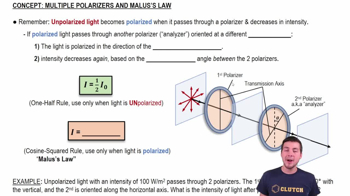
Start by recalling Malus's Law, which describes the intensity of light passing through a polarizing filter. The formula is: I=I01⁢cos2⁢θ, where I is the transmitted intensity, I0 is the initial intensity, and θ is the angle between the transmission axes of the two polarizing filters.
The first polarizing filter reduces the intensity of the unpolarized light by half. Therefore, the intensity after the first filter is: I1=12⁢I0. Substituting the given initial intensity of 350 W/m², we find I1=12⁢350 W/m².
The light then passes through the second polarizing filter. Using Malus's Law, the intensity after the second filter is given by: I2=I1⁢cos2⁢θ. Substituting the known values, I2=131 W/m² and I1=175 W/m², the equation becomes: 131=175⁢cos2⁢θ.
Rearrange the equation to solve for θ. First, divide both sides by 175: 131175=cos2⁢θ. Then, take the square root of both sides: cos⁢θ=131175.
Finally, use the inverse cosine function to find the angle: θ=cos⁢-1⁢131175. This will give the angle of the second polarizing filter's axis relative to the vertical.

Risposta video verificata per un problema simile:

Questa soluzione video è stata consigliata dai nostri tutor come utile per risolvere questo problema.

Concetti chiave

Ecco i concetti essenziali che devi comprendere per rispondere correttamente alla domanda.

Malus's Law

Malus's Law states that when polarized light passes through a polarizing filter, the intensity of the transmitted light is proportional to the square of the cosine of the angle between the light's polarization direction and the filter's axis. Mathematically, it is expressed as I = I₀ cos²(θ), where I₀ is the initial intensity, I is the transmitted intensity, and θ is the angle between the light's polarization direction and the filter's axis.
Video consigliato:
Percorso guidato
09:47
Multiple Polarizers & Malus's Law

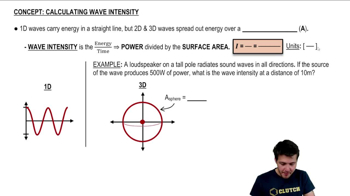
Intensity of Light

The intensity of light is defined as the power per unit area carried by a wave. In the context of polarized light, intensity is crucial for understanding how much light passes through filters. The initial intensity of unpolarized light is halved when it passes through the first polarizing filter, and subsequent filters further modify the intensity based on their orientation relative to the light's polarization.
Video consigliato:

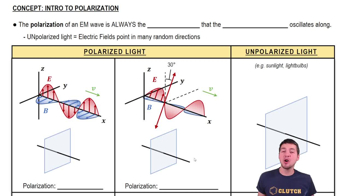
Polarization of Light

Polarization refers to the orientation of the oscillations of light waves. Unpolarized light consists of waves vibrating in multiple planes, while polarized light has waves oscillating in a single plane. Polarizing filters allow only light waves aligned with their axis to pass through, which is essential for analyzing how light intensity changes as it passes through multiple filters at different angles.
Video consigliato:
Percorso guidato
05:32
Introduction to Polarization