Ch 32: AC Circuits
Knight Calc - Physics for Scientists and Engineers 5th Edition
Knight Calc5th EditionPhysics for Scientists and EngineersISBN: 9780137344796Non è quello che usi tu?Cambia libro di testo
Capitolo 32, Problema 19b

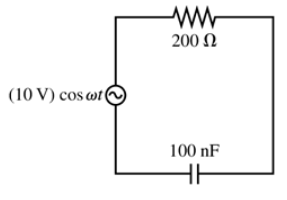
What are VR and VC if the emf frequency in FIGURE EX32.19 is 25 kHz?

Guida verificata passo dopo passo
1
Identify the components of the circuit in FIGURE EX32.19. Typically, this type of problem involves a resistor (R), a capacitor (C), and an inductor (L) in an AC circuit. The voltage across the resistor (Vᵣ) and the capacitor (Vc) need to be determined at a given frequency.
Recall the formulas for the voltage across the resistor and capacitor in an AC circuit. The voltage across the resistor is given by: Vr = I R, where I is the current and R is the resistance. The voltage across the capacitor is given by: Vc = I Xc, where Xc = 1 / (2 π f C) is the capacitive reactance.
Determine the capacitive reactance Xc using the formula: Xc = 1 / (2 π f C). Substitute the given frequency (f = 25 kHz) and the capacitance (C) from the circuit diagram into the formula.
Calculate the current (I) in the circuit. Use Ohm's law for AC circuits: I = \(\text{emf}\) / Z, where Z is the total impedance of the circuit. The impedance Z can be calculated using the formula: Z = \(\text{sqrt}\)(R^2 + (XL - XC)^2), where XL = 2 π f L is the inductive reactance.
Finally, substitute the values of I, R, and Xc into the formulas for Vr and Vc to determine the voltages across the resistor and capacitor, respectively.

Risposta video verificata per un problema simile:

Questa soluzione video è stata consigliata dai nostri tutor come utile per risolvere questo problema.

Concetti chiave

Ecco i concetti essenziali che devi comprendere per rispondere correttamente alla domanda.

Electromotive Force (emf)

Electromotive force (emf) is the voltage generated by a source such as a battery or generator when no current is flowing. It represents the energy per unit charge produced by the source and is crucial for understanding how electrical circuits operate. In the context of alternating current (AC) circuits, the frequency of the emf can affect the behavior of the circuit components.
Video consigliato:

Resonant Frequency

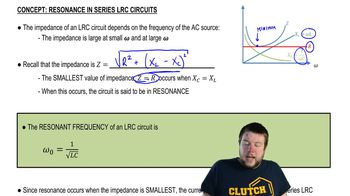
Resonant frequency is the frequency at which a system naturally oscillates when not subjected to a continuous external force. In electrical circuits, this concept is vital for understanding how inductors and capacitors interact, particularly in RLC circuits. At resonant frequency, the impedance is minimized, and the circuit can achieve maximum current flow, which is essential for analyzing the behavior of circuits at specific frequencies.
Video consigliato:
Percorso guidato
05:23
Resonance in Series LRC Circuits

Voltage and Current Relationships in AC Circuits

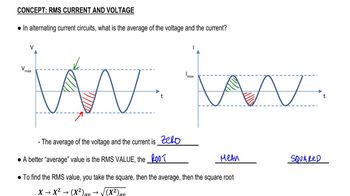
In alternating current (AC) circuits, the relationship between voltage and current is influenced by the circuit's impedance, which includes resistance, inductance, and capacitance. The phase difference between voltage and current can lead to different effective values (RMS) for both quantities. Understanding these relationships is crucial for calculating the voltages (Vᵣ and Vc) across various components in response to a given emf frequency.
Video consigliato:
Percorso guidato
07:14
RMS Current and Voltage