Ch 32: AC Circuits
Knight Calc - Physics for Scientists and Engineers 5th Edition
Knight Calc5th EditionPhysics for Scientists and EngineersISBN: 9780137344796Non è quello che usi tu?Cambia libro di testo
Capitolo 32, Problema 42b

What is the peak voltage across the 3.0 μF capacitor?

Guida verificata passo dopo passo
1
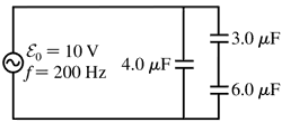
Step 1: Identify the components in the circuit. The circuit consists of an AC voltage source with a peak voltage of 10 V and a frequency of 200 Hz, connected to three capacitors: 4.0 μF, 3.0 μF, and 6.0 μF. The 3.0 μF and 6.0 μF capacitors are in parallel, and this combination is in series with the 4.0 μF capacitor.
Step 2: Calculate the equivalent capacitance of the parallel combination of the 3.0 μF and 6.0 μF capacitors. For capacitors in parallel, the equivalent capacitance is given by: Ceq=C1+C2. Substituting the values: Ceq=3.0+6.0=9.0μF.
Step 3: Calculate the total equivalent capacitance of the circuit. The 9.0 μF equivalent capacitance from Step 2 is in series with the 4.0 μF capacitor. For capacitors in series, the equivalent capacitance is given by: Ceq=11C1+1C2. Substituting the values: Ceq=114.0+19.0.
Step 4: Determine the voltage across the 9.0 μF equivalent capacitance (which includes the 3.0 μF capacitor). The voltage across capacitors in series is divided inversely proportional to their capacitances. Use the formula: V1=Vtotal×CeqC1. Substituting the values for the total voltage (10 V) and the capacitances, calculate the voltage across the 9.0 μF equivalent capacitance.
Step 5: Calculate the voltage across the 3.0 μF capacitor. Since the 3.0 μF and 6.0 μF capacitors are in parallel, they share the same voltage. The voltage across the 3.0 μF capacitor is equal to the voltage across the 9.0 μF equivalent capacitance calculated in Step 4.

Risposta video verificata per un problema simile:

Questa soluzione video è stata consigliata dai nostri tutor come utile per risolvere questo problema.

Concetti chiave

Ecco i concetti essenziali che devi comprendere per rispondere correttamente alla domanda.

Capacitance

Capacitance is the ability of a capacitor to store charge per unit voltage. It is measured in farads (F), with common subunits like microfarads (μF). In this circuit, the capacitors have values of 3.0 μF, 4.0 μF, and 6.0 μF, which determine how much charge they can hold when connected to a voltage source.
Video consigliato:
Percorso guidato
08:02
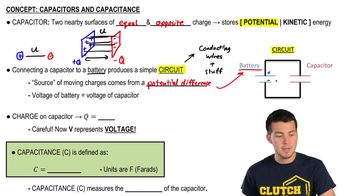
Capacitors & Capacitance (Intro)

AC Voltage and Peak Voltage

In alternating current (AC) circuits, voltage varies sinusoidally over time. The peak voltage (E₀) is the maximum voltage reached in one cycle, which in this case is given as 10 V. Understanding peak voltage is crucial for analyzing how capacitors behave in AC circuits, as it influences the charge stored in the capacitors.
Video consigliato:
Percorso guidato
07:14
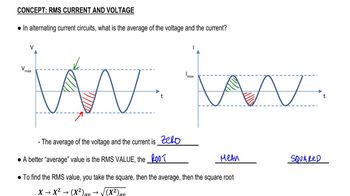
RMS Current and Voltage

Series and Parallel Capacitors

Capacitors can be arranged in series or parallel configurations, affecting the total capacitance of the circuit. In this case, the 3.0 μF and 6.0 μF capacitors are in parallel with the 4.0 μF capacitor. The total capacitance for parallel capacitors is the sum of their capacitances, which is essential for calculating the voltage across each capacitor.
Video consigliato:
Percorso guidato
09:51
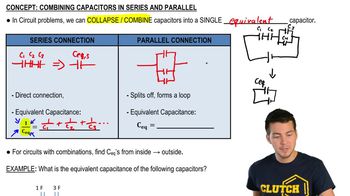
Combining Capacitors in Series & Parallel