Ch 33: Wave Optics
Knight Calc - Physics for Scientists and Engineers 5th Edition
Knight Calc5th EditionPhysics for Scientists and EngineersISBN: 9780137344796Non è quello che usi tu?Cambia libro di testo
Capitolo 33, Problema 17

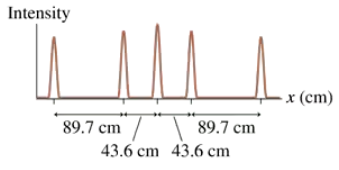
FIGURE EX33.17 shows the interference pattern on a screen 1.0 m behind an 800 lines/mm diffraction grating. What is the wavelength (in nm) of the light?

Guida verificata passo dopo passo
1
Step 1: Understand the problem. The diffraction grating has 800 lines per millimeter, and the screen is located 1.0 m behind the grating. The goal is to calculate the wavelength of the light in nanometers (nm). The diffraction grating equation is used: d sin θ = m λ, where d is the spacing between the lines, θ is the diffraction angle, m is the order of the maximum, and λ is the wavelength.
Step 2: Calculate the grating spacing (d). The grating has 800 lines per millimeter, so the spacing between the lines is the reciprocal of the number of lines per unit length. Convert millimeters to meters: d = \(\frac{1}{800 \times 10^3}\) meters.
Step 3: Identify the diffraction order (m) and the angle (θ) from the interference pattern shown in the figure. The angle θ can be determined geometrically using the position of the bright fringe on the screen and the distance to the screen. Use trigonometry: \(\tan\) θ = \(\frac{y}{L}\), where y is the distance of the fringe from the central maximum and L is the distance to the screen.
Step 4: Rearrange the diffraction grating equation to solve for the wavelength (λ): λ = \(\frac{d \sin θ}{m}\). Substitute the values for d, θ, and m into the equation.
Step 5: Convert the wavelength from meters to nanometers. Since 1 nanometer (nm) is equal to 10^{-9} meters, multiply the result by 10^9 to express the wavelength in nanometers.

Risposta video verificata per un problema simile:

Questa soluzione video è stata consigliata dai nostri tutor come utile per risolvere questo problema.
Durata del video:
9m

Concetti chiave

Ecco i concetti essenziali che devi comprendere per rispondere correttamente alla domanda.

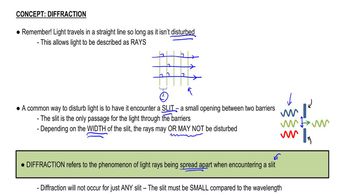
Diffraction Grating

A diffraction grating is an optical component with a periodic structure that splits and diffracts light into several beams. The spacing between the lines on the grating determines the angles at which light of different wavelengths will constructively interfere, creating an interference pattern. In this case, the grating has 800 lines per millimeter, which is crucial for calculating the wavelength of the light.
Video consigliato:

Interference Pattern

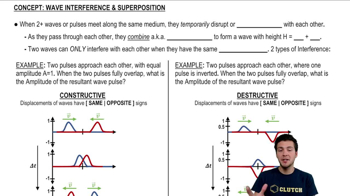
An interference pattern is a series of light and dark bands created when waves overlap and combine. Constructive interference occurs when waves are in phase, leading to bright spots, while destructive interference occurs when waves are out of phase, resulting in dark spots. The pattern observed on the screen is a direct result of the light waves interacting after passing through the diffraction grating.
Video consigliato:
Percorso guidato
03:47
Wave Interference & Superposition

Wavelength Calculation

The wavelength of light can be determined using the formula for diffraction, which relates the angle of the interference pattern to the wavelength, the distance to the screen, and the grating spacing. The formula is given by d sin(θ) = mλ, where d is the distance between grating lines, θ is the angle of the m-th order maximum, and λ is the wavelength. This relationship allows for the calculation of the wavelength based on the observed interference pattern.
Video consigliato:
Percorso guidato
05:42
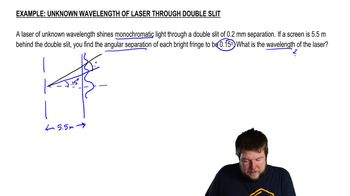
Unknown Wavelength of Laser through Double Slit
Pratica correlata