Ch 33: Wave Optics
Knight Calc - Physics for Scientists and Engineers 5th Edition
Knight Calc5th EditionPhysics for Scientists and EngineersISBN: 9780137344796Non è quello che usi tu?Cambia libro di testo
Capitolo 33, Problema 8

A double-slit interference pattern is created by two narrow slits spaced 0.25 mm apart. The distance between the first and the fifth minimum on a screen 60 cm behind the slits is 5.5 mm. What is the wavelength (in nm) of the light used in this experiment?

Guida verificata passo dopo passo
1
Step 1: Understand the problem. This is a double-slit interference problem where we are tasked with finding the wavelength of light. The key formula for the position of minima in a double-slit interference pattern is: y=md⋅λL, where y is the distance between minima, m is the order of the minima, d is the slit separation, λ is the wavelength, and L is the distance to the screen.
Step 2: Identify the given values. The slit separation is d=0.25 mm (convert to meters: 0.25×10⁻³ m), the distance to the screen is L=60 cm (convert to meters: 0.6 m), and the distance between the first and fifth minima is y=5.5 mm (convert to meters: 5.5×10⁻³ m).
Step 3: Relate the distance between the first and fifth minima to the formula. The distance between the first and fifth minima corresponds to four minima spacings, so y=4⋅λd⋅L. Rearrange this equation to solve for the wavelength λ: λ=y4⋅d⋅L.
Step 4: Substitute the known values into the formula. Using y=5.5×10⁻³ m, d=0.25×10⁻³ m, and L=0.6 m, substitute these into the formula: λ=5.5×10-34⋅0.25×10-3⋅0.6.
Step 5: Simplify the expression to find the wavelength λ. After simplifying, convert the result to nanometers (1 nm = 10-9 m).

Risposta video verificata per un problema simile:

Questa soluzione video è stata consigliata dai nostri tutor come utile per risolvere questo problema.
Durata del video:
7m

Concetti chiave

Ecco i concetti essenziali che devi comprendere per rispondere correttamente alla domanda.

Double-Slit Experiment

The double-slit experiment demonstrates the wave nature of light through interference patterns created when light passes through two closely spaced slits. When coherent light waves overlap, they can constructively or destructively interfere, resulting in a pattern of bright and dark fringes on a screen. This phenomenon is fundamental in understanding wave behavior and is a cornerstone of quantum mechanics.
Video consigliato:
Percorso guidato
12:00
Young's Double Slit Experiment

Interference Pattern

An interference pattern is formed when two or more waves superimpose, leading to regions of constructive interference (bright spots) and destructive interference (dark spots). The positions of these minima and maxima depend on the wavelength of the light and the geometry of the slits. In the context of the double-slit experiment, the distance between these points can be used to calculate the wavelength of the light used.
Video consigliato:
Percorso guidato
03:47
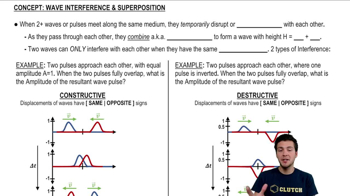
Wave Interference & Superposition

Wavelength Calculation

The wavelength of light can be determined using the formula for the position of minima in a double-slit interference pattern, given by y = (m + 0.5)λL/d, where y is the distance from the central maximum to the m-th minimum, L is the distance to the screen, d is the slit separation, and λ is the wavelength. By rearranging this formula, one can solve for the wavelength when the positions of the minima and the slit separation are known.
Video consigliato:
Percorso guidato
05:42
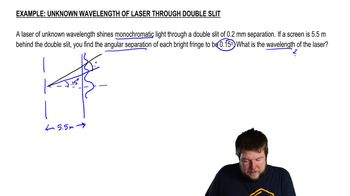
Unknown Wavelength of Laser through Double Slit