Ch 33: Wave Optics
Knight Calc - Physics for Scientists and Engineers 5th Edition
Knight Calc5th EditionPhysics for Scientists and EngineersISBN: 9780137344796Non è quello che usi tu?Cambia libro di testo
Capitolo 33, Problema 3

Light of wavelength 550 nm illuminates a double slit, and the interference pattern is observed on a screen behind the slit. The third maximum is measured to be 3.0 cm from the central maximum. The slits are then illuminated with light of wavelength 440 nm. How far is the fourth maximum from the central maximum?

Guida verificata passo dopo passo
1
Step 1: Understand the problem. The interference pattern is created by light passing through a double slit, and the position of maxima depends on the wavelength of light, the distance between the slits, and the distance to the screen. The formula for the position of maxima is given by: x=mλLd, where x is the position of the maximum, m is the order of the maximum, λ is the wavelength of light, L is the distance to the screen, and d is the distance between the slits.
Step 2: Use the given information for the first wavelength (550 nm) to find the distance to the screen, L. For the third maximum (m=3), the position is given as 3.0 cm. Rearrange the formula to solve for L: L=xdmλ. Substitute the values: x=3.0 cm, λ=550 nm, and m=3. Assume d remains constant.
Step 3: Once L is determined, use the formula again to calculate the position of the fourth maximum (m=4) for the second wavelength (440 nm). Substitute λ=440 nm, m=4, and the previously calculated L into the formula: x=mλLd.
Step 4: Simplify the expression for x using the known values. Ensure the units are consistent (convert nm to cm if necessary). The distance between the slits, d, cancels out as it is constant for both wavelengths.
Step 5: Interpret the result. The calculated value of x represents the position of the fourth maximum for the second wavelength (440 nm) relative to the central maximum. This is the final step in solving the problem.

Risposta video verificata per un problema simile:

Questa soluzione video è stata consigliata dai nostri tutor come utile per risolvere questo problema.
Durata del video:
8m

Concetti chiave

Ecco i concetti essenziali che devi comprendere per rispondere correttamente alla domanda.

Interference Pattern

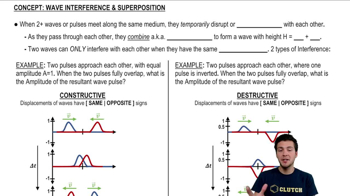
An interference pattern is created when waves, such as light waves, overlap and combine. In a double-slit experiment, constructive interference occurs at specific angles where the path difference between the waves from the two slits is an integer multiple of the wavelength, resulting in bright fringes or maxima. Conversely, destructive interference occurs where the path difference is a half-integer multiple of the wavelength, leading to dark fringes.
Video consigliato:
Percorso guidato
03:47
Wave Interference & Superposition

Wavelength and Maxima Relationship

The position of the maxima in an interference pattern is directly related to the wavelength of the light used. The distance from the central maximum to the nth maximum can be calculated using the formula: y_n = (n * λ * L) / d, where y_n is the distance to the nth maximum, λ is the wavelength, L is the distance from the slits to the screen, and d is the distance between the slits. This relationship shows how changing the wavelength affects the spacing of the maxima.
Video consigliato:
Percorso guidato
03:43
Relationships Between Force, Field, Energy, Potential

Calculating Maximum Positions

To find the position of the maxima for different wavelengths, one can use the previously mentioned formula. For the second wavelength, the same principles apply, but the new wavelength will yield different distances for the maxima. By substituting the new wavelength into the formula, one can calculate the position of the fourth maximum based on the known distance of the third maximum from the first wavelength.
Video consigliato:
Percorso guidato
14:03
Rotational Position & Displacement