Ch 33: Wave Optics
Knight Calc - Physics for Scientists and Engineers 5th Edition
Knight Calc5th EditionPhysics for Scientists and EngineersISBN: 9780137344796Non è quello che usi tu?Cambia libro di testo
Capitolo 33, Problema 43

Two vertical, high-frequency radio antennas are 20 m apart. 2.0 km away, in a plane parallel to the plane of the antennas, 'bright' spots of radio intensity are spaced 5.0 m apart, separated by spots with almost no radio intensity. What is the radio frequency?

Guida verificata passo dopo passo
1
Determine the type of interference pattern: The problem describes alternating 'bright' and 'dark' spots, which indicates constructive and destructive interference. This is a result of the wave nature of radio waves and their superposition.
Use the formula for constructive interference: The condition for constructive interference is given by \( d \sin \theta = m \lambda \), where \( d \) is the distance between the antennas (20 m), \( \theta \) is the angle of the bright spot relative to the central axis, \( m \) is the order of the bright spot (an integer), and \( \lambda \) is the wavelength of the radio waves.
Relate the geometry to the interference pattern: The bright spots are spaced 5.0 m apart at a distance of 2.0 km (2000 m) from the antennas. The angle \( \theta \) for each bright spot can be approximated using \( \tan \theta \approx \sin \theta \approx \frac{x}{L} \), where \( x \) is the spacing between bright spots (5.0 m) and \( L \) is the distance to the observation plane (2000 m).
Calculate the wavelength \( \lambda \): Substitute \( \sin \theta \approx \frac{x}{L} \) into the interference condition \( d \sin \theta = m \lambda \). For the first-order bright spot (\( m = 1 \)), this simplifies to \( \lambda = \frac{d \cdot x}{L} \).
Determine the frequency \( f \): Use the wave equation \( v = f \lambda \), where \( v \) is the speed of the radio waves (equal to the speed of light, \( 3.0 \times 10^8 \ \text{m/s} \)). Rearrange to find \( f = \frac{v}{\lambda} \). Substitute the calculated \( \lambda \) into this equation to find the radio frequency.

Risposta video verificata per un problema simile:

Questa soluzione video è stata consigliata dai nostri tutor come utile per risolvere questo problema.

Concetti chiave

Ecco i concetti essenziali che devi comprendere per rispondere correttamente alla domanda.

Interference Patterns

Interference patterns occur when two or more waves overlap, leading to regions of constructive and destructive interference. In this scenario, the bright spots represent areas of constructive interference where the radio waves from the antennas reinforce each other, while the dark spots indicate destructive interference where the waves cancel each other out.
Video consigliato:
Percorso guidato
03:47
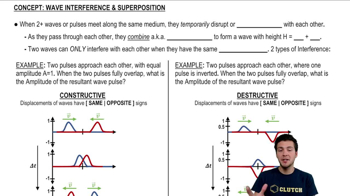
Wave Interference & Superposition

Wavelength and Frequency Relationship

The relationship between wavelength (λ) and frequency (f) of a wave is described by the equation v = fλ, where v is the speed of the wave. For radio waves, this speed is approximately the speed of light in a vacuum. Understanding this relationship is crucial for calculating the frequency based on the observed spacing of the bright spots.
Video consigliato:
Percorso guidato
05:08
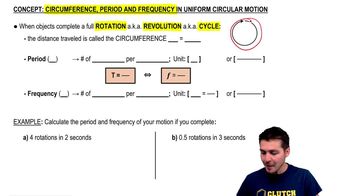
Circumference, Period, and Frequency in UCM

Path Difference

Path difference is the difference in distance traveled by two waves arriving at a point. For constructive interference to occur at the bright spots, the path difference must be an integer multiple of the wavelength. In this problem, the geometry of the antennas and the distance to the observation plane will help determine the path difference and, consequently, the frequency of the radio waves.
Video consigliato:
Pratica correlata
Domanda del libro di testo

Use your expression from part a to find an expression for the separation Δy on the screen of two fringes that differ in wavelength by Δλ.

1594
views

Domanda del libro di testo

White light (400–700 nm) incident on a 600 lines/mm diffraction grating produces rainbows of diffracted light. What is the width of the first-order rainbow on a screen 2.0 m behind the grating?

89
views
Domanda del libro di testo

FIGURE P33.39 shows the light intensity on a screen 2.5 m behind an aperture. The aperture is illuminated with light of wavelength 620 nm. Is the aperture a single slit or a double slit? Explain.

94
views
Domanda del libro di testo

FIGURE P33.40 shows the light intensity on a screen 2.5 m behind an aperture. The aperture is illuminated with light of wavelength 620 nm. If the aperture is a single slit, what is its width? If it is a double slit, what is the spacing between the slits?

71
views
Domanda del libro di testo

Helium atoms emit light at several wavelengths. Light from a helium lamp illuminates a diffraction grating and is observed on a screen 50.00 cm behind the grating. The emission at wavelength 501.5 nm creates a first-order bright fringe 21.90 cm from the central maximum. What is the wavelength of the bright fringe that is 31.60 cm from the central maximum?

96
views
Domanda del libro di testo

A Michelson interferometer uses red light with a wavelength of 656.45 nm from a hydrogen discharge lamp. How many bright-dark-bright fringe shifts are observed if mirror M₂ is moved exactly 1 cm?

1455
views