Ch 33: Wave Optics
Knight Calc - Physics for Scientists and Engineers 5th Edition
Knight Calc5th EditionPhysics for Scientists and EngineersISBN: 9780137344796Non è quello che usi tu?Cambia libro di testo
Capitolo 33, Problema 37

A Michelson interferometer uses red light with a wavelength of 656.45 nm from a hydrogen discharge lamp. How many bright-dark-bright fringe shifts are observed if mirror M₂ is moved exactly 1 cm?

Guida verificata passo dopo passo
1
Understand the concept: In a Michelson interferometer, fringe shifts occur when one of the mirrors is moved, causing a change in the optical path length. Each fringe shift corresponds to a change in the path length equal to one wavelength of the light used.
Calculate the total change in the optical path length: When mirror M₂ is moved by a distance \( d \), the optical path length changes by \( 2d \) because the light travels to the mirror and back. Here, \( d = 1 \; \text{cm} = 0.01 \; \text{m} \).
Determine the number of wavelengths in the total path length change: The number of fringe shifts \( N \) is given by \( N = \frac{2d}{\lambda} \), where \( \lambda \) is the wavelength of the light. Substitute \( \lambda = 656.45 \; \text{nm} = 656.45 \times 10^{-9} \; \text{m} \).
Substitute the values into the formula: Replace \( d \) and \( \lambda \) in the equation \( N = \frac{2d}{\lambda} \) to calculate the number of fringe shifts.
Interpret the result: The calculated value of \( N \) represents the total number of bright-dark-bright fringe shifts observed as the mirror is moved by 1 cm.

Risposta video verificata per un problema simile:

Questa soluzione video è stata consigliata dai nostri tutor come utile per risolvere questo problema.
Durata del video:
3m

Concetti chiave

Ecco i concetti essenziali che devi comprendere per rispondere correttamente alla domanda.

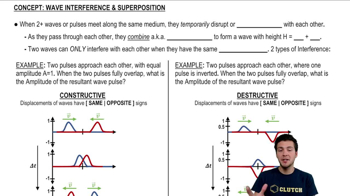
Interference

Interference is a phenomenon that occurs when two or more waves overlap and combine to form a new wave pattern. In the context of the Michelson interferometer, constructive interference leads to bright fringes, while destructive interference results in dark fringes. The pattern of these fringes is crucial for analyzing the changes in path length caused by moving mirrors.
Video consigliato:
Percorso guidato
03:47
Wave Interference & Superposition

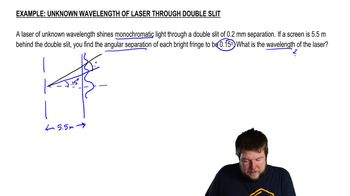
Wavelength

Wavelength is the distance between successive peaks of a wave, typically measured in nanometers (nm) for light. In this question, the red light has a wavelength of 656.45 nm, which is essential for calculating the number of fringe shifts. The wavelength determines how many times the light wave can fit into the distance moved by the mirror.
Video consigliato:
Percorso guidato
05:42
Unknown Wavelength of Laser through Double Slit

Fringe Shift Calculation

Fringe shift calculation involves determining how many times the light wave's path length changes in relation to its wavelength when a mirror is moved. For every full wavelength (2 times the distance moved by the mirror), a bright fringe shifts to a dark fringe or vice versa. Thus, moving mirror M₂ by 1 cm will result in a specific number of fringe shifts based on the wavelength of the light used.
Video consigliato:
Percorso guidato
09:05
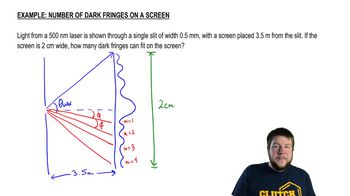
Number of Dark Fringes on a Screen
Pratica correlata
Domanda del libro di testo

Infrared light of wavelength 2.5 μm illuminates a 0.20-mm-diameter hole. What is the angle of the first dark fringe in radians? In degrees?

89
views

Domanda del libro di testo

Light from a helium-neon laser (λ = 633 nm) passes through a circular aperture and is observed on a screen 4.0 m behind the aperture. The width of the central maximum is 2.5 cm. What is the diameter (in mm) of the hole?

73
views
Domanda del libro di testo

FIGURE P33.39 shows the light intensity on a screen 2.5 m behind an aperture. The aperture is illuminated with light of wavelength 620 nm. Is the aperture a single slit or a double slit? Explain.

94
views
Domanda del libro di testo

Two vertical, high-frequency radio antennas are 20 m apart. 2.0 km away, in a plane parallel to the plane of the antennas, 'bright' spots of radio intensity are spaced 5.0 m apart, separated by spots with almost no radio intensity. What is the radio frequency?

119
views
Domanda del libro di testo

You want to photograph a circular diffraction pattern whose central maximum has a diameter of 1.0 cm. You have a helium-neon laser (λ=633 nm) and a 0.12-mm-diameter pinhole. How far behind the pinhole should you place the screen that's to be photographed?

77
views
Domanda del libro di testo

FIGURE P33.40 shows the light intensity on a screen 2.5 m behind an aperture. The aperture is illuminated with light of wavelength 620 nm. If the aperture is a single slit, what is its width? If it is a double slit, what is the spacing between the slits?

71
views