
Ch 33: Wave Optics
Knight Calc - Physics for Scientists and Engineers 5th Edition
Knight Calc5th EditionPhysics for Scientists and EngineersISBN: 9780137344796Non è quello che usi tu?Cambia libro di testo
Capitolo 33, Problema 31

Your artist friend is designing an exhibit inspired by circular-aperture diffraction. A pinhole in a red zone is going to be illuminated with a red laser beam of wavelength 670 nm, while a pinhole in a violet zone is going to be illuminated with a violet laser beam of wavelength 410 nm. She wants all the diffraction patterns seen on a distant screen to have the same size. For this to work, what must be the ratio of the red pinhole’s diameter to that of the violet pinhole?

Guida verificata passo dopo passo
1
Understand the concept of circular-aperture diffraction: The size of the diffraction pattern is determined by the angular width of the central maximum, which depends on the wavelength of the light and the diameter of the aperture.
Recall the formula for the angular width of the central maximum in circular-aperture diffraction: \( \theta = 1.22 \frac{\lambda}{D} \), where \( \lambda \) is the wavelength of the light and \( D \) is the diameter of the aperture.
To ensure the diffraction patterns have the same size, the angular width \( \theta \) must be the same for both the red and violet beams. Set the angular widths equal: \( 1.22 \frac{\lambda_{\text{red}}}{D_{\text{red}}} = 1.22 \frac{\lambda_{\text{violet}}}{D_{\text{violet}}} \).
Simplify the equation by canceling the constant \( 1.22 \): \( \frac{\lambda_{\text{red}}}{D_{\text{red}}} = \frac{\lambda_{\text{violet}}}{D_{\text{violet}}} \). Rearrange to find the ratio of the diameters: \( \frac{D_{\text{red}}}{D_{\text{violet}}} = \frac{\lambda_{\text{red}}}{\lambda_{\text{violet}}} \).
Substitute the given wavelengths: \( \lambda_{\text{red}} = 670 \, \text{nm} \) and \( \lambda_{\text{violet}} = 410 \, \text{nm} \). The ratio of the diameters is \( \frac{D_{\text{red}}}{D_{\text{violet}}} = \frac{670}{410} \).

Risposta video verificata per un problema simile:

Questa soluzione video è stata consigliata dai nostri tutor come utile per risolvere questo problema.
Durata del video:
4m

Concetti chiave

Ecco i concetti essenziali che devi comprendere per rispondere correttamente alla domanda.

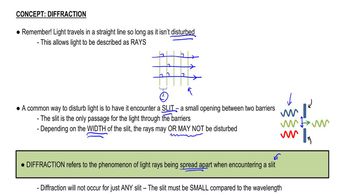
Diffraction

Diffraction is the bending of waves around obstacles and the spreading of waves when they pass through small openings. In the context of light, diffraction patterns arise when coherent light sources, like lasers, pass through apertures, creating interference patterns on a screen. The extent of diffraction is influenced by the wavelength of the light and the size of the aperture.
Video consigliato:

Wavelength and Aperture Size

The wavelength of light is a critical factor in determining the diffraction pattern produced by an aperture. According to the principles of diffraction, a smaller aperture size relative to the wavelength results in more pronounced diffraction. To achieve similar diffraction patterns for different wavelengths, the ratio of the diameters of the apertures must be adjusted based on their respective wavelengths.
Video consigliato:
Percorso guidato
05:42
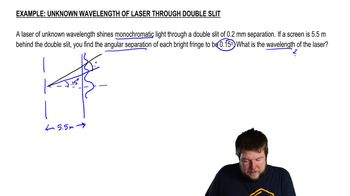
Unknown Wavelength of Laser through Double Slit

Ratio of Aperture Diameters

To ensure that diffraction patterns from two different wavelengths appear the same size on a screen, the ratio of the diameters of the apertures must be inversely proportional to the ratio of the wavelengths. This means that if one wavelength is longer, its corresponding aperture must be smaller to maintain the same diffraction pattern size, allowing for a direct comparison of the two patterns.
Video consigliato:
Percorso guidato
05:32
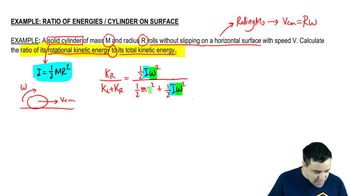
Ratio of energies of cylinder on surface
Pratica correlata
Domanda del libro di testo

Two 50-μm-wide slits spaced 0.25 mm apart are illuminated by blue laser light with a wavelength of 450 nm. The interference pattern is observed on a screen 2.0 m behind the slits. How many bright fringes are seen in the central maximum that spans the distance between the first missing order on one side and the first missing order on the other side?

137
views
Domanda del libro di testo

Infrared light of wavelength 2.5 μm illuminates a 0.20-mm-diameter hole. What is the angle of the first dark fringe in radians? In degrees?

89
views
Domanda del libro di testo

Light from a helium-neon laser (λ = 633 nm) passes through a circular aperture and is observed on a screen 4.0 m behind the aperture. The width of the central maximum is 2.5 cm. What is the diameter (in mm) of the hole?

73
views
Domanda del libro di testo

Figure EX33.26 shows the light intensity on a screen behind a single slit. The wavelength of the light is 600 nm and the slit width is 0.15 mm. What is the distance from the slit to the screen?

115
views
Domanda del libro di testo

Light of 600 nm wavelength passes through a single slit and creates a 2.0-cm-wide central maximum on a screen behind the slit. What wavelength of light will create a 3.0-cm-wide central maximum on a screen twice as far away?

119
views
Domanda del libro di testo

You want to photograph a circular diffraction pattern whose central maximum has a diameter of 1.0 cm. You have a helium-neon laser (λ=633 nm) and a 0.12-mm-diameter pinhole. How far behind the pinhole should you place the screen that's to be photographed?

77
views