
Ch 33: Wave Optics
Knight Calc - Physics for Scientists and Engineers 5th Edition
Knight Calc5th EditionPhysics for Scientists and EngineersISBN: 9780137344796Non è quello che usi tu?Cambia libro di testo
Capitolo 33, Problema 33

Infrared light of wavelength 2.5 μm illuminates a 0.20-mm-diameter hole. What is the angle of the first dark fringe in radians? In degrees?

Guida verificata passo dopo passo
1
Step 1: Recognize that this is a diffraction problem involving a circular aperture. The angle to the first dark fringe for a circular aperture is given by the formula: θ=1.22×λD, where λ is the wavelength of the light and D is the diameter of the aperture.
Step 2: Convert the given values into consistent SI units. The wavelength λ is given as 2.5 μm, which is equivalent to 2.5×10⁻6 meters. The diameter D is given as 0.20 mm, which is equivalent to 2.0×10⁻4 meters.
Step 3: Substitute the values of λ and D into the formula for θ: θ=1.22×2.5×10⁻62.0×10⁻4. Simplify the fraction to find θ in radians.
Step 4: To convert the angle from radians to degrees, use the conversion factor: 1 rad=180π deg. Multiply the angle in radians by this factor to find the angle in degrees.
Step 5: Verify the units and ensure the calculations are consistent. The final answers will be the angle of the first dark fringe in both radians and degrees.

Risposta video verificata per un problema simile:

Questa soluzione video è stata consigliata dai nostri tutor come utile per risolvere questo problema.

Concetti chiave

Ecco i concetti essenziali che devi comprendere per rispondere correttamente alla domanda.

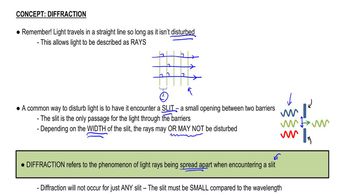
Diffraction

Diffraction is the bending of waves around obstacles and the spreading of waves when they pass through small openings. In the context of light, diffraction patterns are created when light waves encounter an aperture, leading to regions of constructive and destructive interference. This phenomenon is crucial for understanding how light behaves when it passes through the hole mentioned in the question.
Video consigliato:

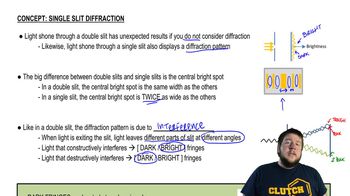
Single-Slit Diffraction

Single-slit diffraction refers to the pattern of light and dark fringes produced when light passes through a narrow slit or hole. The angle of the dark fringes can be calculated using the formula sin(θ) = mλ/a, where m is the order of the dark fringe, λ is the wavelength of light, and a is the width of the slit. This concept is essential for determining the angle of the first dark fringe in the given problem.
Video consigliato:
Percorso guidato
12:33
Single Slit Diffraciton

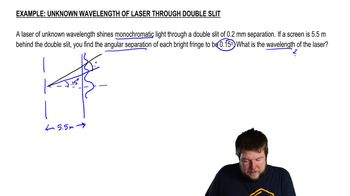
Wavelength

Wavelength is the distance between successive peaks of a wave, typically measured in meters or micrometers for light. It is a fundamental property of waves that influences their behavior, including diffraction patterns. In this question, the wavelength of the infrared light (2.5 μm) is critical for calculating the angle of the dark fringe, as it directly affects the spacing of the diffraction pattern.
Video consigliato:
Percorso guidato
05:42
Unknown Wavelength of Laser through Double Slit
Pratica correlata
Domanda del libro di testo

Two 50-μm-wide slits spaced 0.25 mm apart are illuminated by blue laser light with a wavelength of 450 nm. The interference pattern is observed on a screen 2.0 m behind the slits. How many bright fringes are seen in the central maximum that spans the distance between the first missing order on one side and the first missing order on the other side?

137
views
Domanda del libro di testo

Your artist friend is designing an exhibit inspired by circular-aperture diffraction. A pinhole in a red zone is going to be illuminated with a red laser beam of wavelength 670 nm, while a pinhole in a violet zone is going to be illuminated with a violet laser beam of wavelength 410 nm. She wants all the diffraction patterns seen on a distant screen to have the same size. For this to work, what must be the ratio of the red pinhole’s diameter to that of the violet pinhole?

471
views
Domanda del libro di testo

Light from a helium-neon laser (λ = 633 nm) passes through a circular aperture and is observed on a screen 4.0 m behind the aperture. The width of the central maximum is 2.5 cm. What is the diameter (in mm) of the hole?

73
views
Domanda del libro di testo

Figure EX33.26 shows the light intensity on a screen behind a single slit. The wavelength of the light is 600 nm and the slit width is 0.15 mm. What is the distance from the slit to the screen?

115
views
Domanda del libro di testo

You want to photograph a circular diffraction pattern whose central maximum has a diameter of 1.0 cm. You have a helium-neon laser (λ=633 nm) and a 0.12-mm-diameter pinhole. How far behind the pinhole should you place the screen that's to be photographed?

77
views
Domanda del libro di testo

A Michelson interferometer uses red light with a wavelength of 656.45 nm from a hydrogen discharge lamp. How many bright-dark-bright fringe shifts are observed if mirror M₂ is moved exactly 1 cm?

1455
views