Ch 34: Ray Optics
Knight Calc - Physics for Scientists and Engineers 5th Edition
Knight Calc5th EditionPhysics for Scientists and EngineersISBN: 9780137344796Non è quello che usi tu?Cambia libro di testo
Capitolo 34, Problema 1b

What distance does light travel in water, glass, and cubic zirconia during the time that it travels 1.0 m in vacuum?

Guida verificata passo dopo passo
1
Determine the speed of light in a vacuum, which is approximately \( c = 3.0 \times 10^8 \, \text{m/s} \). This is the reference speed for light in a vacuum.
Identify the refractive indices of water, glass, and cubic zirconia. These values are typically \( n_{\text{water}} \approx 1.33 \), \( n_{\text{glass}} \approx 1.5 \), and \( n_{\text{cubic zirconia}} \approx 2.2 \). The refractive index \( n \) relates the speed of light in a medium to the speed of light in a vacuum.
Use the relationship \( v = \frac{c}{n} \) to calculate the speed of light in each medium. Here, \( v \) is the speed of light in the medium, \( c \) is the speed of light in a vacuum, and \( n \) is the refractive index of the medium.
Calculate the time it takes for light to travel 1.0 m in a vacuum using \( t = \frac{d}{c} \), where \( d = 1.0 \, \text{m} \) and \( c = 3.0 \times 10^8 \, \text{m/s} \). This time will be the same for light traveling in the other media.
Determine the distance light travels in each medium using \( d = v \cdot t \), where \( v \) is the speed of light in the medium (calculated in step 3) and \( t \) is the time calculated in step 4. Perform this calculation for water, glass, and cubic zirconia to find the respective distances.

Risposta video verificata per un problema simile:

Questa soluzione video è stata consigliata dai nostri tutor come utile per risolvere questo problema.

Concetti chiave

Ecco i concetti essenziali che devi comprendere per rispondere correttamente alla domanda.

Speed of Light

The speed of light in a vacuum is approximately 299,792 kilometers per second (or about 3.00 x 10^8 m/s). This constant is fundamental in physics and serves as a benchmark for understanding how light behaves in different media. When light travels through materials like water, glass, or cubic zirconia, its speed decreases due to interactions with the atoms in those materials.
Video consigliato:
Percorso guidato
06:03
The Doppler Effect (Light)

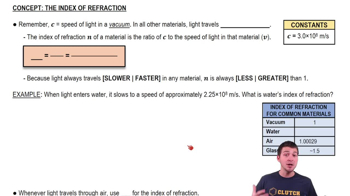
Refractive Index

The refractive index is a dimensionless number that describes how light propagates through a medium compared to its speed in a vacuum. It is defined as the ratio of the speed of light in vacuum to the speed of light in the medium. For example, water has a refractive index of about 1.33, meaning light travels slower in water than in vacuum, which affects the distance light travels in that medium over a given time.
Video consigliato:
Percorso guidato
03:46
Index of Refraction

Distance Calculation in Different Media

To determine the distance light travels in various media during the time it takes to travel 1.0 m in vacuum, one must use the formula: distance = speed × time. The time taken for light to travel 1.0 m in vacuum can be calculated, and then this time can be used with the speed of light in each medium (derived from the refractive index) to find the corresponding distances in water, glass, and cubic zirconia.
Video consigliato:
Percorso guidato
04:15
Calculating Dot Product Using Vector Components