

Ch 34: Ray Optics
Knight Calc - Physics for Scientists and Engineers 5th Edition
Knight Calc5th EditionPhysics for Scientists and EngineersISBN: 9780137344796Non è quello che usi tu?Cambia libro di testo
Capitolo 34, Problema 2

A point source of light illuminates an aperture 2.0 m away. A 12.0-cm-wide bright patch of light appears on a screen 1.0 m behind the aperture. How wide is the aperture?

Guida verificata passo dopo passo
1
Understand the problem: The light from a point source passes through an aperture and forms a bright patch on a screen. The goal is to determine the width of the aperture. This involves using the concept of similar triangles formed by the light rays passing through the aperture and projecting onto the screen.
Define the geometry: The distance from the point source to the aperture is \( d_1 = 2.0 \; \text{m} \), the distance from the aperture to the screen is \( d_2 = 1.0 \; \text{m} \), and the width of the bright patch on the screen is \( W_2 = 12.0 \; \text{cm} = 0.12 \; \text{m} \). Let the width of the aperture be \( W_1 \).
Set up the relationship using similar triangles: The light rays form two similar triangles—one with the aperture and the point source, and the other with the bright patch on the screen. The ratio of corresponding sides of these triangles is equal: \( \frac{W_1}{d_1} = \frac{W_2}{d_1 + d_2} \).
Rearrange the equation to solve for \( W_1 \): Multiply both sides by \( d_1 \) to isolate \( W_1 \): \( W_1 = \frac{W_2 \cdot d_1}{d_1 + d_2} \).
Substitute the known values into the equation: Replace \( W_2 = 0.12 \; \text{m} \), \( d_1 = 2.0 \; \text{m} \), and \( d_2 = 1.0 \; \text{m} \) into the formula to calculate \( W_1 \). This will give the width of the aperture.

Risposta video verificata per un problema simile:

Questa soluzione video è stata consigliata dai nostri tutor come utile per risolvere questo problema.

Concetti chiave

Ecco i concetti essenziali che devi comprendere per rispondere correttamente alla domanda.

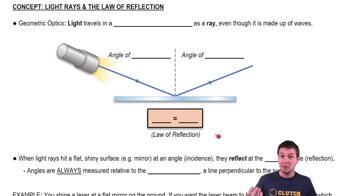
Geometric Optics

Geometric optics is the study of light propagation in terms of rays. It simplifies the behavior of light by treating it as straight lines, which is particularly useful for analyzing how light interacts with objects like apertures and lenses. This concept is essential for understanding how light spreads from a point source and forms images on screens.
Video consigliato:
Percorso guidato
06:25
Law of Reflection

Similar Triangles

The concept of similar triangles is fundamental in geometry, where two triangles are similar if their corresponding angles are equal and their sides are in proportion. In this problem, the relationship between the width of the aperture, the distance to the screen, and the width of the bright patch can be analyzed using similar triangles to derive the width of the aperture.
Video consigliato:
Percorso guidato
01:53
Charges In A Triangle (Rank Force Pairs)

Light Divergence

Light divergence refers to the spreading of light rays as they travel away from a point source. As light moves from the aperture to the screen, it diverges, creating a wider patch of light. Understanding this concept helps in calculating how the width of the aperture affects the size of the illuminated area on the screen.
Video consigliato:
Percorso guidato
10:30
Ray Nature of Light