Ch 38: Quantization
Knight Calc - Physics for Scientists and Engineers 5th Edition
Knight Calc5th EditionPhysics for Scientists and EngineersISBN: 9780137344796Non è quello che usi tu?Cambia libro di testo
Capitolo 38, Problema 68a

INT A beam of electrons is incident upon a gas of hydrogen atoms. What minimum speed must the electrons have to cause the emission of 656 nm light from the 3→2 transition of hydrogen?

Guida verificata passo dopo passo
1
Determine the energy of the emitted photon corresponding to the 656 nm wavelength using the equation for photon energy: \( E = \frac{hc}{\lambda} \), where \( h \) is Planck's constant, \( c \) is the speed of light, and \( \lambda \) is the wavelength of the emitted light.
Calculate the energy difference between the \( n=3 \) and \( n=2 \) energy levels of the hydrogen atom using the formula for the energy levels of hydrogen: \( E_n = -\frac{13.6}{n^2} \; \text{eV} \). Subtract \( E_2 \) from \( E_3 \) to find the energy required for the transition.
Recognize that for the 3→2 transition to occur, the incident electron must transfer at least this energy to the hydrogen atom. This means the kinetic energy of the electron must be equal to or greater than the energy difference calculated in the previous step.
Relate the kinetic energy of the electron to its speed using the formula \( KE = \frac{1}{2}mv^2 \), where \( m \) is the mass of the electron and \( v \) is its speed. Solve for \( v \) by setting \( KE \) equal to the energy difference from step 2.
Substitute the known values for the mass of the electron, the energy difference, and any necessary constants into the equation to calculate the minimum speed of the electron.

Risposta video verificata per un problema simile:

Questa soluzione video è stata consigliata dai nostri tutor come utile per risolvere questo problema.

Concetti chiave

Ecco i concetti essenziali che devi comprendere per rispondere correttamente alla domanda.

Photon Emission and Energy Levels

In hydrogen atoms, electrons occupy discrete energy levels. When an electron transitions from a higher energy level (n=3) to a lower one (n=2), it emits a photon with a specific wavelength, in this case, 656 nm. The energy of the emitted photon corresponds to the difference in energy between these two levels, which can be calculated using the formula E = hc/λ, where h is Planck's constant and c is the speed of light.
Video consigliato:
Percorso guidato
04:10
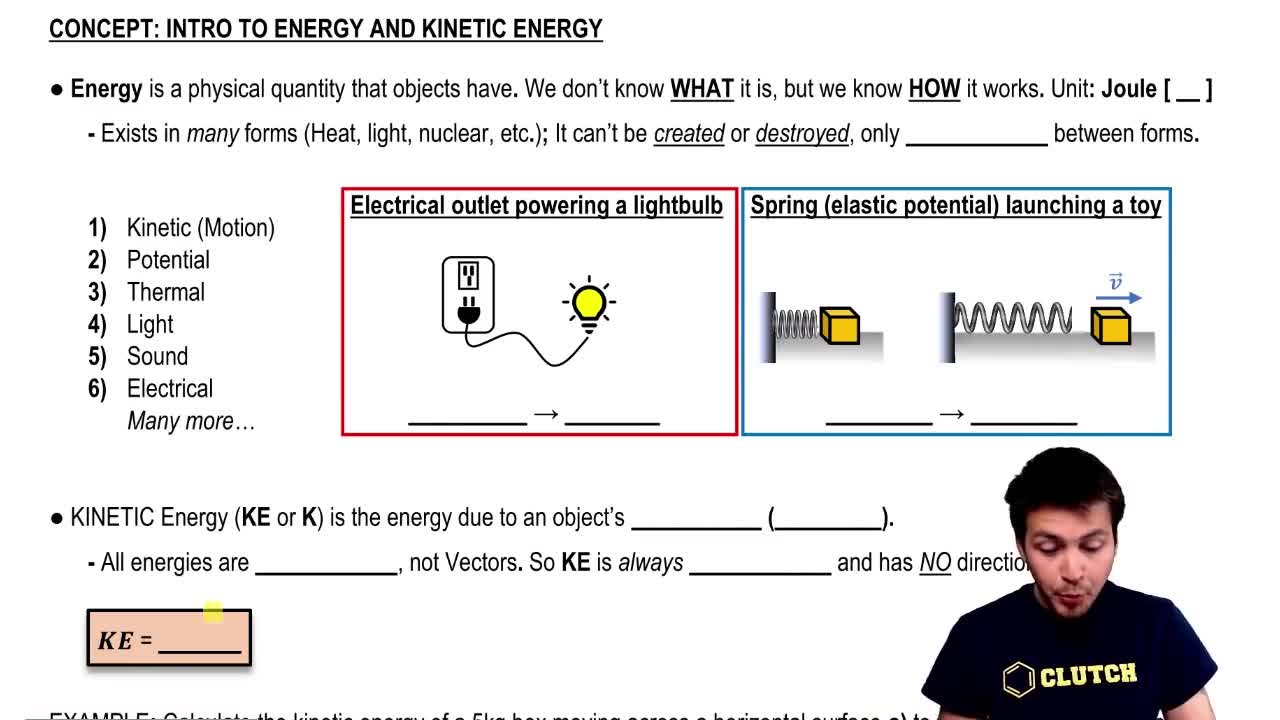
Intro to Energy & Types of Energy

Kinetic Energy of Electrons

The kinetic energy of an electron is given by the equation KE = 1/2 mv², where m is the mass of the electron and v is its velocity. To cause the emission of a photon, the incident electron must have sufficient kinetic energy to excite the hydrogen atom to the required energy level. This means the kinetic energy must be equal to or greater than the energy difference between the initial and final states of the hydrogen atom.
Video consigliato:
Percorso guidato
06:07
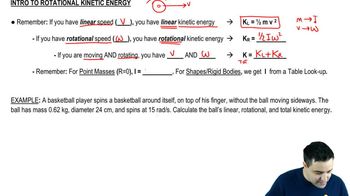
Intro to Rotational Kinetic Energy

Threshold Energy and Ionization

Threshold energy refers to the minimum energy required to initiate a process, such as exciting an electron in an atom. For the hydrogen atom's 3→2 transition, the incident electron must have enough energy to overcome the energy difference between these levels. If the energy is too low, no photon will be emitted; if it is too high, it may lead to ionization, where the electron is completely removed from the atom.
Video consigliato:
Percorso guidato
04:10
Intro to Energy & Types of Energy
Pratica correlata
Domanda del libro di testo

INT A beam of electrons is incident upon a gas of hydrogen atoms. Through what potential difference must the electrons be accelerated to have this speed?

111
views

Domanda del libro di testo

In the atom interferometer experiment of Figure 38.13, laser-cooling techniques were used to cool a dilute vapor of sodium atoms to a temperature of 0.0010 K=1.0 mK. The ultracold atoms passed through a series of collimating apertures to form the atomic beam you see entering the figure from the left. The standing light waves were created from a laser beam with a wavelength of 590 nm. Because interference is observed between the two paths, each individual atom is apparently present at both point B and point C. Describe, in your own words, what this experiment tells you about the nature of matter.

1442
views
Domanda del libro di testo

Very large, hot stars—much hotter than our sun—can be identified by the way in which He+ ions in their atmosphere absorb light. What are the three longest wavelengths, in nm, in the Balmer series of He+?

58
views
Domanda del libro di testo

Draw an energy-level diagram, similar to Figure 38.21, for the He+ ion. On your diagram: Show all possible emission transitions from the n = 4 energy level.

88
views
Domanda del libro di testo

The electrons in a cathode-ray tube are accelerated through a 250 V potential difference and then shot through a 33-nm-diameter circular aperture. What is the diameter of the bright spot on an electron detector 1.5 m behind the aperture?

78
views
Domanda del libro di testo

INT Two hydrogen atoms collide head-on. The collision brings both atoms to a halt. Immediately after the collision, both atoms emit a 121.6 nm photon. What was the speed of each atom just before the collision?

1460
views