Ch 38: Quantization
Knight Calc - Physics for Scientists and Engineers 5th Edition
Knight Calc5th EditionPhysics for Scientists and EngineersISBN: 9780137344796Non è quello che usi tu?Cambia libro di testo
Capitolo 38, Problema 67

INT Two hydrogen atoms collide head-on. The collision brings both atoms to a halt. Immediately after the collision, both atoms emit a 121.6 nm photon. What was the speed of each atom just before the collision?

Guida verificata passo dopo passo
1
Determine the energy of the emitted photon using the formula for photon energy: E=hc/λ, where h is Planck's constant, c is the speed of light, and λ is the wavelength of the photon (121.6 nm).
Recognize that the total energy of the system before the collision is equal to the total energy after the collision due to conservation of energy. The kinetic energy of the two hydrogen atoms before the collision is converted into the energy of the emitted photons.
Write the expression for the total kinetic energy of the two hydrogen atoms before the collision: K=12mv2+12mv2, where m is the mass of a hydrogen atom and v is the speed of each atom (since they are identical).
Set the total kinetic energy of the two atoms equal to the total energy of the two emitted photons: 212mv2=2E. Simplify this equation to solve for v.
Substitute the known values for E, m (mass of a hydrogen atom), and constants (h, c, and λ) into the equation to calculate the speed v of each hydrogen atom before the collision.

Risposta video verificata per un problema simile:

Questa soluzione video è stata consigliata dai nostri tutor come utile per risolvere questo problema.
Durata del video:
12m

Concetti chiave

Ecco i concetti essenziali che devi comprendere per rispondere correttamente alla domanda.

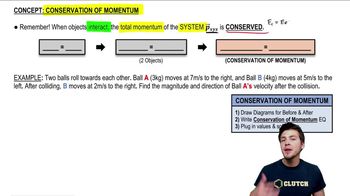
Conservation of Momentum

In a closed system, the total momentum before a collision is equal to the total momentum after the collision. For two hydrogen atoms colliding head-on and coming to a halt, their initial momenta must have been equal and opposite, allowing us to analyze their speeds before the collision based on the final state.
Video consigliato:
Percorso guidato
05:58
Conservation Of Momentum

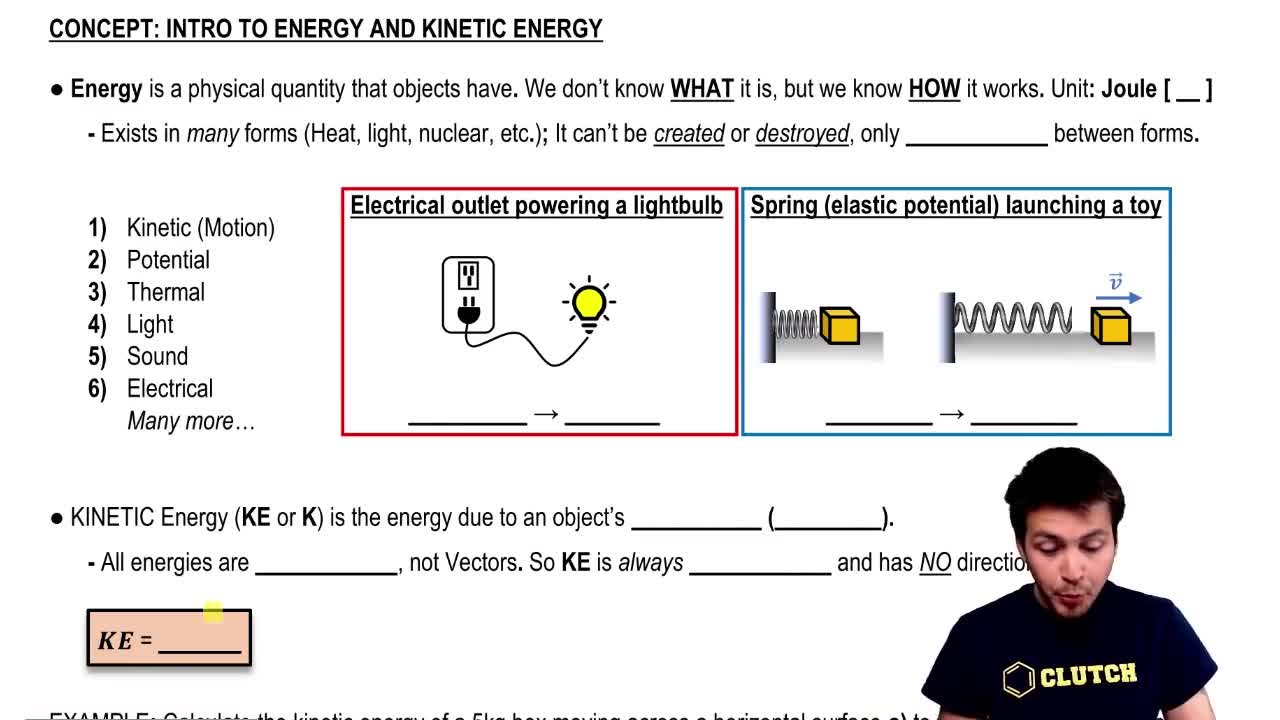
Photon Emission and Energy

When the hydrogen atoms collide and come to a stop, they release energy in the form of a photon. The energy of the emitted photon can be calculated using the equation E = hc/λ, where h is Planck's constant, c is the speed of light, and λ is the wavelength of the photon. This energy corresponds to the kinetic energy lost by the atoms during the collision.
Video consigliato:
Percorso guidato
04:10
Intro to Energy & Types of Energy

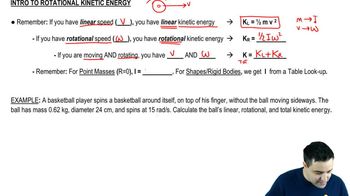
Kinetic Energy

Kinetic energy is the energy an object possesses due to its motion, given by the formula KE = 1/2 mv², where m is mass and v is velocity. In this scenario, the initial kinetic energy of the hydrogen atoms can be equated to the energy of the emitted photon, allowing us to solve for the speed of each atom just before the collision.
Video consigliato:
Percorso guidato
06:07
Intro to Rotational Kinetic Energy