Ch 38: Quantization
Knight Calc - Physics for Scientists and Engineers 5th Edition
Knight Calc5th EditionPhysics for Scientists and EngineersISBN: 9780137344796Non è quello che usi tu?Cambia libro di testo
Capitolo 38, Problema 30

What is the radius of a hydrogen atom whose electron moves at 7.3×10⁵ m/s?

Guida verificata passo dopo passo
1
Understand that the problem involves the Bohr model of the hydrogen atom, which describes the electron orbiting the nucleus in quantized energy levels. The radius of the orbit can be determined using the centripetal force provided by the Coulomb force.
Write the expression for the centripetal force: Fc = mv2r, where m is the mass of the electron, v is its velocity, and r is the radius of the orbit.
Write the expression for the Coulomb force: FC = ke2r2, where k is Coulomb's constant, and e is the charge of the electron.
Set the centripetal force equal to the Coulomb force: mv2r = ke2r2. Solve for r by isolating it on one side of the equation.
Substitute the known values: m = 9.11 × 10⁻³¹ kg, v = 7.3 × 10⁵ m/s, k = 8.99 × 10⁹ N·m2/C2, and e = 1.6 × 10⁻¹⁹ C. Simplify the expression to find the radius r.

Risposta video verificata per un problema simile:

Questa soluzione video è stata consigliata dai nostri tutor come utile per risolvere questo problema.

Concetti chiave

Ecco i concetti essenziali che devi comprendere per rispondere correttamente alla domanda.

Bohr Model of the Atom

The Bohr model describes the hydrogen atom as having electrons in fixed orbits around the nucleus, with quantized energy levels. According to this model, the radius of the electron's orbit can be calculated using specific formulas that relate the electron's velocity and the fundamental constants of the atom.
Video consigliato:

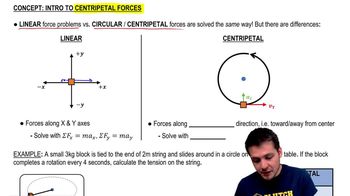
Centripetal Force

In the context of atomic structure, centripetal force is the force that keeps the electron in its circular orbit around the nucleus. This force is provided by the electrostatic attraction between the positively charged nucleus and the negatively charged electron, and it can be equated to the required centripetal force for circular motion.
Video consigliato:
Percorso guidato
06:48
Intro to Centripetal Forces

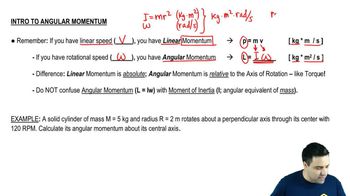
Quantization of Angular Momentum

In the Bohr model, angular momentum of the electron is quantized, meaning it can only take on certain discrete values. This principle leads to the derivation of specific radii for electron orbits, where the angular momentum is an integer multiple of Planck's constant divided by 2π, influencing the size of the hydrogen atom.
Video consigliato:
Percorso guidato
06:18
Intro to Angular Momentum