Ch 39: Wave Functions and Uncertainty
Knight Calc - Physics for Scientists and Engineers 5th Edition
Knight Calc5th EditionPhysics for Scientists and EngineersISBN: 9780137344796Non è quello che usi tu?Cambia libro di testo
Capitolo 39, Problema 36c

Consider the electron wave function ψ(x)={c1−x2∣x∣≤1 cm0∣x∣≥1 cm\(\psi\) (x)=\(\begin{cases}\) c\(\sqrt{1-x^{2}\)} & \(\left\)|x\(\right\)|\(\leq\) 1\(\text{ cm}\) \\ 0 & \(\left\)|x\(\right\)|\(\geq\) 1\(\text{ cm}\) \(\end{cases}\) where x is in cm. Draw a graph of |ψ(x)|2 over the interval −2 cm ≤ x ≤ 2 cm. Provide numerical scales.

Guida verificata passo dopo passo
1
Understand the problem: The wave function ψ(x) is defined piecewise. For |x| ≤ 1 cm, ψ(x) = √c(1 − x²), and for |x| > 1 cm, ψ(x) = 0. The task is to graph |ψ(x)|², which represents the probability density, over the interval −2 cm ≤ x ≤ 2 cm.
Step 1: Recall that |ψ(x)|² is the square of the magnitude of the wave function. For |x| ≤ 1 cm, |ψ(x)|² = (√c(1 − x²))² = c(1 − x²)². For |x| > 1 cm, |ψ(x)|² = 0 because ψ(x) = 0 in this region.
Step 2: Identify the domain of the function. The non-zero part of |ψ(x)|² exists only for |x| ≤ 1 cm, i.e., −1 cm ≤ x ≤ 1 cm. Outside this range (|x| > 1 cm), |ψ(x)|² = 0.
Step 3: Plot the function |ψ(x)|² = c(1 − x²)² for −1 cm ≤ x ≤ 1 cm. This is a symmetric function about x = 0 because it depends on x². The value of |ψ(x)|² is maximum at x = 0 (where |ψ(x)|² = c) and decreases to 0 at x = ±1 cm.
Step 4: Extend the graph to the interval −2 cm ≤ x ≤ 2 cm. For −2 cm ≤ x < −1 cm and 1 cm < x ≤ 2 cm, |ψ(x)|² = 0. Label the x-axis with a scale from −2 cm to 2 cm and the y-axis with a scale that includes the maximum value of |ψ(x)|², which is c.

Risposta video verificata per un problema simile:

Questa soluzione video è stata consigliata dai nostri tutor come utile per risolvere questo problema.

Concetti chiave

Ecco i concetti essenziali che devi comprendere per rispondere correttamente alla domanda.

Wave Function

The wave function, denoted as ψ(x), describes the quantum state of a particle, such as an electron, in a given position x. It contains all the information about the system and is a complex-valued function. The square of the absolute value of the wave function, |ψ(x)|^2, represents the probability density of finding the particle at position x.
Video consigliato:
Percorso guidato
08:30
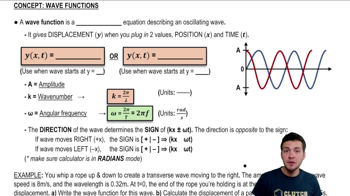
Intro to Wave Functions

Probability Density

Probability density is a measure that describes the likelihood of finding a particle in a specific region of space. For a wave function ψ(x), the probability density is given by |ψ(x)|^2. In this context, it indicates how the electron's presence is distributed across the defined interval, which is crucial for understanding its behavior in quantum mechanics.
Video consigliato:
Percorso guidato
8:13
Intro to Density

Graphing Functions

Graphing functions involves plotting the values of a function on a coordinate system to visualize its behavior. In this case, we will graph |ψ(x)|^2 over the interval from -2 cm to 2 cm, which helps illustrate the regions where the electron is most likely to be found. Proper numerical scales on the axes are essential for accurately interpreting the graph.
Video consigliato:
Percorso guidato
08:30
Intro to Wave Functions
Pratica correlata
Domanda del libro di testo

A particle is described by the wave function ψ(x)={cex/Lx≤0 mmce−x/Lx≥0 mm\(\psi\) (x)=\(\begin{cases}\) ce^{x/L} & x\(\leq\) 0\(\text{ mm}\) \\ ce^{-x/L} & x\(\geq\) 0\(\text{ mm}\) \(\end{cases}\) mm where L = 2.0 mm. Determine the normalization constant c.

55
views

Domanda del libro di testo

FIGURE P39.31 shows the wave function of a particle confined between x = 0 nm and x = 1.0 nm. The wave function is zero outside this region. Calculate the probability of finding the particle in the interval 0 nm ≤ x ≤ 0.25 nm.

46
views
Domanda del libro di testo

A particle is described by the wave function ψ(x)={cex/Lx≤0 mmce−x/Lx≥0 mm\(\psi\) (x)=\(\begin{cases}\) ce^{x/L} & x\(\leq\) 0\(\text{ mm}\) \\ ce^{-x/L} & x\(\geq\) 0\(\text{ mm}\) \(\end{cases}\) where L = 2.0 mm. Sketch graphs of both the wave function and the probability density as functions of x.

64
views
Domanda del libro di testo

Consider the electron wave function ψ(x)={c1−x2∣x∣≤1 cm0∣x∣≥1 cm\(\psi\) (x)=\(\begin{cases}\) c\(\sqrt{1-x^{2}\)} & \(\left\)|x\(\right\)|\(\leq\) 1\(\text{ cm}\) \\ 0 & \(\left\)|x\(\right\)|\(\geq\) 1\(\text{ cm}\) \(\end{cases}\) where x is in cm. Draw a graph of ψ(x) over the interval −2 cm ≤ x ≤ 2 cm. Provide numerical scales on both axes.

42
views
Domanda del libro di testo

Consider the electron wave function ψ(x)={c1−x2∣x∣≤1 cm0∣x∣≥1 cm\(\psi\) (x)=\(\begin{cases}\) c\(\sqrt{1-x^{2}\)} & \(\left\)|x\(\right\)|\(\leq\) 1\(\text{ cm}\) \\ 0 & \(\left\)|x\(\right\)|\(\geq\) 1\(\text{ cm}\) \(\end{cases}\) where x is in cm. Determine the normalization constant c.

57
views
Domanda del libro di testo

A particle is described by the wave function ψ(x)={cex/Lx≤0 mmce−x/Lx≥0 mm\(\psi\) (x)=\(\begin{cases}\) ce^{x/L} & x\(\leq\) 0\(\text{ mm}\) \\ ce^{-x/L} & x\(\geq\) 0\(\text{ mm}\) \(\end{cases}\) where L = 2.0 mm. Calculate the probability of finding the particle within 1.0 mm of the origin.

1579
views