Ch 39: Wave Functions and Uncertainty
Knight Calc - Physics for Scientists and Engineers 5th Edition
Knight Calc5th EditionPhysics for Scientists and EngineersISBN: 9780137344796Non è quello che usi tu?Cambia libro di testo
Capitolo 39, Problema 36b

Consider the electron wave function ψ(x)={c1−x2∣x∣≤1 cm0∣x∣≥1 cm\(\psi\) (x)=\(\begin{cases}\) c\(\sqrt{1-x^{2}\)} & \(\left\)|x\(\right\)|\(\leq\) 1\(\text{ cm}\) \\ 0 & \(\left\)|x\(\right\)|\(\geq\) 1\(\text{ cm}\) \(\end{cases}\) where x is in cm. Draw a graph of ψ(x) over the interval −2 cm ≤ x ≤ 2 cm. Provide numerical scales on both axes.

Guida verificata passo dopo passo
1
Understand the given wave function: The wave function ψ(x) is defined piecewise. For |x| ≤ 1 cm, ψ(x) = √c (1 − x²), and for |x| > 1 cm, ψ(x) = 0. This means the wave function is nonzero only in the interval −1 cm ≤ x ≤ 1 cm and is zero elsewhere.
Identify the domain for the graph: The problem asks for the graph of ψ(x) over the interval −2 cm ≤ x ≤ 2 cm. Since ψ(x) = 0 for |x| > 1 cm, the graph will show ψ(x) = 0 for x < −1 cm and x > 1 cm.
Plot the nonzero part of ψ(x): For −1 cm ≤ x ≤ 1 cm, calculate ψ(x) = √c (1 − x²). This is a parabolic function that opens downward because of the negative x² term. The maximum value of ψ(x) occurs at x = 0, where ψ(0) = √c. At x = ±1 cm, ψ(x) = 0.
Add numerical scales to the axes: The x-axis should range from −2 cm to 2 cm, and the y-axis should range from 0 to the maximum value of ψ(x), which is √c. Label the key points, such as ψ(0) = √c and ψ(±1) = 0.
Combine the pieces: Draw the graph by plotting the parabolic curve for −1 cm ≤ x ≤ 1 cm and horizontal lines at ψ(x) = 0 for x < −1 cm and x > 1 cm. Ensure the graph transitions smoothly at x = ±1 cm, where ψ(x) becomes zero.

Risposta video verificata per un problema simile:

Questa soluzione video è stata consigliata dai nostri tutor come utile per risolvere questo problema.

Concetti chiave

Ecco i concetti essenziali che devi comprendere per rispondere correttamente alla domanda.

Wave Function

The wave function, denoted as ψ(x), describes the quantum state of a particle, such as an electron, in a given position x. It contains all the information about the system and is used to calculate probabilities of finding the particle in various states. The square of the wave function's absolute value, |ψ(x)|², gives the probability density of the particle's position.
Video consigliato:
Percorso guidato
08:30
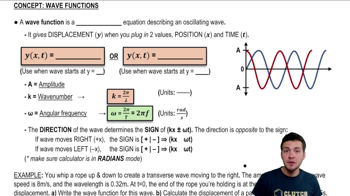
Intro to Wave Functions

Normalization

Normalization is a crucial concept in quantum mechanics that ensures the total probability of finding a particle in all possible positions equals one. For a wave function to be physically meaningful, it must be normalized over its entire domain. This involves integrating the square of the wave function over the specified range and adjusting the constant factor (c in this case) accordingly.
Video consigliato:
Percorso guidato
08:17
The Normal Force

Graphing Functions

Graphing functions involves plotting the values of a function on a coordinate system, where the x-axis represents the independent variable (position x) and the y-axis represents the dependent variable (the wave function ψ(x)). In this case, the graph will illustrate the behavior of the wave function within the specified interval, highlighting regions where the wave function is non-zero and its shape, which is essential for visualizing quantum states.
Video consigliato:
Percorso guidato
08:30
Intro to Wave Functions
Pratica correlata
Domanda del libro di testo

A particle is described by the wave function ψ(x)={cex/Lx≤0 mmce−x/Lx≥0 mm\(\psi\) (x)=\(\begin{cases}\) ce^{x/L} & x\(\leq\) 0\(\text{ mm}\) \\ ce^{-x/L} & x\(\geq\) 0\(\text{ mm}\) \(\end{cases}\) mm where L = 2.0 mm. Determine the normalization constant c.

55
views

Domanda del libro di testo

Consider the electron wave function ψ(x)={c1−x2∣x∣≤1 cm0∣x∣≥1 cm\(\psi\) (x)=\(\begin{cases}\) c\(\sqrt{1-x^{2}\)} & \(\left\)|x\(\right\)|\(\leq\) 1\(\text{ cm}\) \\ 0 & \(\left\)|x\(\right\)|\(\geq\) 1\(\text{ cm}\) \(\end{cases}\) where x is in cm. Draw a graph of |ψ(x)|2 over the interval −2 cm ≤ x ≤ 2 cm. Provide numerical scales.

41
views
Domanda del libro di testo

FIGURE P39.31 shows the wave function of a particle confined between x = 0 nm and x = 1.0 nm. The wave function is zero outside this region. Calculate the probability of finding the particle in the interval 0 nm ≤ x ≤ 0.25 nm.

46
views
Domanda del libro di testo

A particle is described by the wave function ψ(x)={cex/Lx≤0 mmce−x/Lx≥0 mm\(\psi\) (x)=\(\begin{cases}\) ce^{x/L} & x\(\leq\) 0\(\text{ mm}\) \\ ce^{-x/L} & x\(\geq\) 0\(\text{ mm}\) \(\end{cases}\) where L = 2.0 mm. Sketch graphs of both the wave function and the probability density as functions of x.

64
views
Domanda del libro di testo

FIGURE P39.31 shows the wave function of a particle confined between x = 0 nm and x = 1.0 nm. The wave function is zero outside this region. Draw a graph of the probability density P(x)=|ψ(x)|2

61
views
Domanda del libro di testo

Consider the electron wave function ψ(x)={c1−x2∣x∣≤1 cm0∣x∣≥1 cm\(\psi\) (x)=\(\begin{cases}\) c\(\sqrt{1-x^{2}\)} & \(\left\)|x\(\right\)|\(\leq\) 1\(\text{ cm}\) \\ 0 & \(\left\)|x\(\right\)|\(\geq\) 1\(\text{ cm}\) \(\end{cases}\) where x is in cm. Determine the normalization constant c.

57
views