Ch 39: Wave Functions and Uncertainty
Knight Calc - Physics for Scientists and Engineers 5th Edition
Knight Calc5th EditionPhysics for Scientists and EngineersISBN: 9780137344796Non è quello che usi tu?Cambia libro di testo
Capitolo 39, Problema 14c

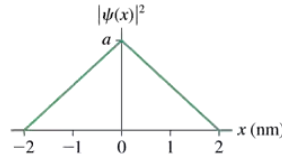
FIGURE EX39.14 is a graph of |ψ(x)|2 for an electron. What is the probability that the electron is located between x = 1.0 nm and x = 2.0 nm?

Guida verificata passo dopo passo
1
Step 1: Understand the problem. The graph of |ψ(x)|² represents the probability density function for the electron's position. To find the probability that the electron is located between x = 1.0 nm and x = 2.0 nm, we need to integrate |ψ(x)|² over this interval.
Step 2: Write the integral expression for the probability. The probability P is given by: P = ∫1.02.0|ψ(x)|² dx. This integral calculates the area under the curve of |ψ(x)|² between x = 1.0 nm and x = 2.0 nm.
Step 3: Analyze the graph of |ψ(x)|² provided in FIGURE EX39.14. Identify the functional form of |ψ(x)|² or approximate the values if the graph is discrete or irregular. If the graph provides a specific function, substitute it into the integral.
Step 4: Perform the integration. Depending on the functional form of |ψ(x)|², use appropriate integration techniques (e.g., analytical integration for simple functions or numerical methods for complex or discrete data). Ensure the limits of integration are x = 1.0 nm and x = 2.0 nm.
Step 5: Interpret the result of the integration. The value obtained from the integral represents the probability that the electron is located between x = 1.0 nm and x = 2.0 nm. Ensure the result is consistent with the physical interpretation of probabilities (i.e., it should be a number between 0 and 1).

Risposta video verificata per un problema simile:

Questa soluzione video è stata consigliata dai nostri tutor come utile per risolvere questo problema.
Durata del video:
6m

Concetti chiave

Ecco i concetti essenziali che devi comprendere per rispondere correttamente alla domanda.

Wave Function and Probability Density

In quantum mechanics, the wave function, denoted as ψ(x), describes the quantum state of a particle. The square of the absolute value of the wave function, |ψ(x)|^2, represents the probability density, indicating the likelihood of finding the particle at a specific position. This concept is fundamental for understanding how quantum particles behave and how their locations can be predicted.
Video consigliato:
Percorso guidato
08:30
Intro to Wave Functions

Integration of Probability Density

To find the probability of a particle being located within a specific range, one must integrate the probability density over that range. For the given question, this involves calculating the integral of |ψ(x)|^2 from x=1.0 nm to x=2.0 nm. This process quantifies the total probability of finding the electron in the specified interval, which is a key aspect of quantum mechanics.
Video consigliato:
Percorso guidato
11:43
Finding Moment Of Inertia By Integrating

Normalization of the Wave Function

The wave function must be normalized, meaning that the total probability of finding the particle in all space equals one. This ensures that the probabilities derived from |ψ(x)|^2 are meaningful. Normalization is crucial for accurate calculations in quantum mechanics, as it establishes a consistent framework for interpreting probabilities associated with particle locations.
Video consigliato:
Percorso guidato
08:30
Intro to Wave Functions