Ch 39: Wave Functions and Uncertainty
Knight Calc - Physics for Scientists and Engineers 5th Edition
Knight Calc5th EditionPhysics for Scientists and EngineersISBN: 9780137344796Non è quello che usi tu?Cambia libro di testo
Capitolo 39, Problema 12b

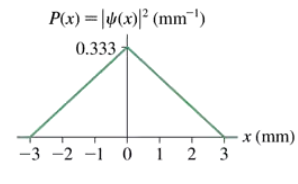
FIGURE EX39.12 shows the probability density for an electron that has passed through an experimental apparatus. If 1.0×10⁶ electrons are used, what is the expected number that will land in a 0.010-mm-wide strip at 2.000 mm?

Guida verificata passo dopo passo
1
Step 1: Understand the problem. The graph provided shows the probability density function P(x) = |ψ(x)|² (in mm⁻¹) for the electron's position. The goal is to calculate the expected number of electrons landing in a 0.010-mm-wide strip at x = 2.000 mm, given that 1.0×10⁶ electrons are used.
Step 2: Identify the probability density at x = 2.000 mm. From the graph, the probability density P(x) at x = 2.000 mm is determined by the triangular shape. The value of P(x) at x = 2.000 mm can be read or calculated using the slope of the triangle.
Step 3: Calculate the probability of an electron landing in the 0.010-mm-wide strip. The probability is given by multiplying the probability density P(x) at x = 2.000 mm by the width of the strip (Δx = 0.010 mm). Use the formula: P_strip = P(x) × Δx.
Step 4: Determine the expected number of electrons in the strip. Multiply the probability P_strip by the total number of electrons (N = 1.0×10⁶). Use the formula: N_strip = P_strip × N.
Step 5: Combine the results. Substitute the values for P(x), Δx, and N into the formulas from Steps 3 and 4 to find the expected number of electrons landing in the strip. Ensure units are consistent throughout the calculation.

Risposta video verificata per un problema simile:

Questa soluzione video è stata consigliata dai nostri tutor come utile per risolvere questo problema.

Concetti chiave

Ecco i concetti essenziali che devi comprendere per rispondere correttamente alla domanda.

Probability Density

Probability density describes the likelihood of finding a particle, such as an electron, in a specific region of space. It is represented mathematically as the square of the wave function's amplitude, |ψ(x)|². In this context, the area under the probability density curve over a given interval indicates the probability of locating the electron within that interval.
Video consigliato:
Percorso guidato
8:13
Intro to Density

Normalization of Probability Density

Normalization ensures that the total probability of finding a particle within the entire space equals one. For a probability density function, this means integrating the probability density over all possible positions must yield a value of one. In the given figure, the area under the curve from -3 mm to 3 mm should equal one, confirming that the function is properly normalized.
Video consigliato:
Percorso guidato
08:17
The Normal Force

Expected Value Calculation

The expected value in a probabilistic context is the average outcome one would anticipate from a large number of trials. For this question, it involves multiplying the total number of electrons (1.0×10⁶) by the probability of finding an electron in the specified 0.010-mm-wide strip at 2.000 mm, derived from the probability density function. This calculation provides the expected number of electrons landing in that strip.
Video consigliato:
Percorso guidato
8:42
Density Values & Conversions