Ch 39: Wave Functions and Uncertainty
Knight Calc - Physics for Scientists and Engineers 5th Edition
Knight Calc5th EditionPhysics for Scientists and EngineersISBN: 9780137344796Non è quello che usi tu?Cambia libro di testo
Capitolo 39, Problema 8

In one experiment, 2000 photons are detected in a 0.10-mm-wide strip where the amplitude of the electromagnetic wave is 10 V/m. How many photons are detected in a nearby 0.10-mm-wide strip where the amplitude is 30 V/m?

Guida verificata passo dopo passo
1
Understand that the number of photons detected is proportional to the intensity of the electromagnetic wave, and the intensity is proportional to the square of the amplitude of the wave. This means \( I \propto A^2 \), where \( I \) is the intensity and \( A \) is the amplitude.
Write the relationship between the number of photons detected \( N \) and the amplitude \( A \): \( N \propto A^2 \). This implies \( \frac{N_2}{N_1} = \frac{A_2^2}{A_1^2} \), where \( N_1 \) and \( N_2 \) are the number of photons detected in the first and second strips, and \( A_1 \) and \( A_2 \) are their respective amplitudes.
Substitute the given values for \( A_1 \) and \( A_2 \): \( A_1 = 10 \, \text{V/m} \) and \( A_2 = 30 \, \text{V/m} \). The equation becomes \( \frac{N_2}{N_1} = \frac{(30)^2}{(10)^2} \).
Simplify the ratio: \( \frac{N_2}{N_1} = \frac{900}{100} = 9 \). This means the number of photons detected in the second strip is 9 times the number detected in the first strip.
Multiply the number of photons detected in the first strip by this ratio to find \( N_2 \): \( N_2 = 9 \times 2000 \). This gives the number of photons detected in the second strip.

Risposta video verificata per un problema simile:

Questa soluzione video è stata consigliata dai nostri tutor come utile per risolvere questo problema.

Concetti chiave

Ecco i concetti essenziali che devi comprendere per rispondere correttamente alla domanda.

Photon Detection

Photon detection refers to the process of identifying and counting individual photons, which are the fundamental particles of light. The number of detected photons can be influenced by factors such as the intensity of the light source and the area over which the detection occurs. In this context, the experiment measures how varying the amplitude of the electromagnetic wave affects the number of photons detected in a specified area.
Video consigliato:
Percorso guidato
07:11
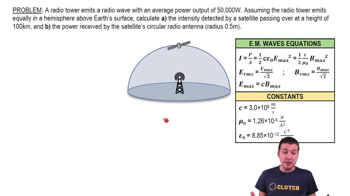
Intensity of EM Waves Example 2

Amplitude of Electromagnetic Waves

The amplitude of an electromagnetic wave is a measure of the maximum electric field strength of the wave. It is directly related to the intensity of the wave, which is proportional to the square of the amplitude. Higher amplitude indicates a stronger wave, which can lead to a greater number of photons being emitted or detected, as seen in the comparison between the two strips in the experiment.
Video consigliato:
Percorso guidato
05:22
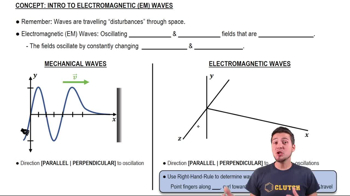
Introduction to Electromagnetic (EM) Waves

Intensity and Photon Flux

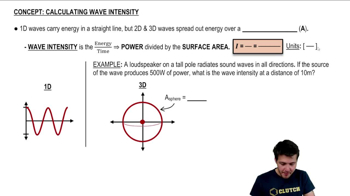
Intensity in the context of electromagnetic waves is defined as the power per unit area and is proportional to the square of the amplitude. Photon flux, which is the number of photons passing through a unit area per unit time, increases with higher intensity. Therefore, by understanding the relationship between intensity, amplitude, and photon detection, one can calculate the expected number of photons detected in different conditions.
Video consigliato: