Ch 41: Atomic Physics
Knight Calc - Physics for Scientists and Engineers 5th Edition
Knight Calc5th EditionPhysics for Scientists and EngineersISBN: 9780137344796Non è quello che usi tu?Cambia libro di testo
Capitolo 41, Problema 5b

A hydrogen atom has orbital angular momentum 3.65 × 10⁻³⁴ J s. What is the atom's minimum possible energy? Explain.

Guida verificata passo dopo passo
1
Determine the quantum number (l) associated with the given orbital angular momentum. The orbital angular momentum is given by the formula: L = √(l(l+1))ℏ, where ℏ is the reduced Planck's constant (ℏ = 1.054 × 10⁻³⁴ J·s). Rearrange this formula to solve for l.
Substitute the given value of L (3.65 × 10⁻³⁴ J·s) and ℏ into the equation L = √(l(l+1))ℏ. Solve for l by isolating it and squaring both sides of the equation.
Once the quantum number l is determined, recall that the principal quantum number n must be greater than or equal to l + 1. This is because n is the principal quantum number, and l is the orbital quantum number, which ranges from 0 to n-1.
The minimum possible energy of the hydrogen atom corresponds to the energy level associated with the principal quantum number n. Use the formula for the energy levels of a hydrogen atom: E_n = -13.6 \, \(\text{eV}\) / n². Substitute the smallest possible value of n (determined in the previous step) into this formula.
Convert the energy from electron volts (eV) to joules if needed, using the conversion factor 1 \, \(\text{eV}\) = 1.602 × 10⁻¹⁹ J. This will give the minimum possible energy of the hydrogen atom in joules.

Risposta video verificata per un problema simile:

Questa soluzione video è stata consigliata dai nostri tutor come utile per risolvere questo problema.

Concetti chiave

Ecco i concetti essenziali che devi comprendere per rispondere correttamente alla domanda.

Orbital Angular Momentum

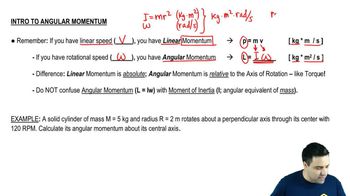
Orbital angular momentum is a measure of the rotational motion of an electron around the nucleus of an atom. It is quantized, meaning it can only take on specific discrete values, which are determined by the quantum number associated with the electron's orbital. In the case of a hydrogen atom, the angular momentum can be calculated using the formula L = mvr, where m is the mass, v is the velocity, and r is the radius of the orbit.
Video consigliato:
Percorso guidato
06:18
Intro to Angular Momentum

Energy Levels in Hydrogen Atom

In a hydrogen atom, electrons occupy specific energy levels, which are quantized. The energy of these levels is given by the formula E_n = -13.6 eV/n², where n is the principal quantum number. The minimum possible energy corresponds to the ground state (n=1), and as n increases, the energy becomes less negative, indicating that the electron is less tightly bound to the nucleus.
Video consigliato:

Relation Between Angular Momentum and Energy

In quantum mechanics, there is a relationship between an atom's angular momentum and its energy levels. For hydrogen, the angular momentum is quantized in units of ħ (reduced Planck's constant), and the energy levels can be derived from the angular momentum values. The minimum energy can be calculated using the angular momentum value provided, allowing us to determine the corresponding energy state of the atom.
Video consigliato:
Percorso guidato
06:18
Intro to Angular Momentum