Ch 41: Atomic Physics
Knight Calc - Physics for Scientists and Engineers 5th Edition
Knight Calc5th EditionPhysics for Scientists and EngineersISBN: 9780137344796Non è quello che usi tu?Cambia libro di testo
Capitolo 41, Problema 2

What is the angular momentum of a hydrogen atom in (a) a 6s state and (b) a 4f state? Give your answers as a multiple of ℏ .

Guida verificata passo dopo passo
1
Understand the concept of angular momentum in quantum mechanics: The angular momentum of an electron in an atom is quantized and determined by the orbital quantum number \( l \). The magnitude of the angular momentum is given by \( \sqrt{l(l+1)} \hbar \), where \( \hbar \) is the reduced Planck's constant.
Identify the orbital quantum number \( l \) for the given states: The quantum number \( l \) is associated with the type of orbital. For an \( s \)-state, \( l = 0 \); for a \( f \)-state, \( l = 3 \).
For part (a), calculate the angular momentum for the 6s state: Since \( l = 0 \) for an \( s \)-state, substitute \( l = 0 \) into the formula \( \sqrt{l(l+1)} \hbar \). This simplifies to \( \sqrt{0(0+1)} \hbar = 0 \hbar \).
For part (b), calculate the angular momentum for the 4f state: Since \( l = 3 \) for an \( f \)-state, substitute \( l = 3 \) into the formula \( \sqrt{l(l+1)} \hbar \). This becomes \( \sqrt{3(3+1)} \hbar = \sqrt{12} \hbar \).
Express the results: The angular momentum for the 6s state is \( 0 \hbar \), and for the 4f state, it is \( \sqrt{12} \hbar \), which can also be written as \( 2\sqrt{3} \hbar \).

Risposta video verificata per un problema simile:

Questa soluzione video è stata consigliata dai nostri tutor come utile per risolvere questo problema.

Concetti chiave

Ecco i concetti essenziali che devi comprendere per rispondere correttamente alla domanda.

Angular Momentum

Angular momentum is a physical quantity that represents the rotational inertia and rotational velocity of an object. In quantum mechanics, it is quantized and can be described using the formula L = r × p, where L is angular momentum, r is the position vector, and p is the linear momentum. For atomic systems, angular momentum is often expressed in terms of the reduced Planck constant (ℏ), with specific values determined by the quantum state of the system.
Video consigliato:
Percorso guidato
06:18
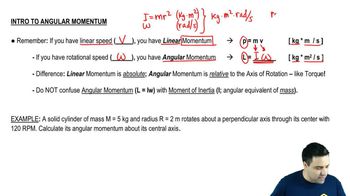
Intro to Angular Momentum

Quantum States and Quantum Numbers

Quantum states of an atom are defined by quantum numbers, which describe the energy levels, angular momentum, and magnetic orientation of electrons. The principal quantum number (n) indicates the energy level, while the azimuthal quantum number (l) determines the shape of the orbital and the angular momentum. For example, in a 6s state, n=6 and l=0, while in a 4f state, n=4 and l=3, which directly influences the angular momentum calculations.
Video consigliato:
Percorso guidato
07:19
Moles & Avogadro's Number

Quantization of Angular Momentum

In quantum mechanics, angular momentum is quantized, meaning it can only take on specific discrete values. The magnitude of angular momentum for an electron in an atom is given by the formula L = √(l(l+1))ℏ, where l is the azimuthal quantum number. This quantization leads to distinct angular momentum values for different electron states, which are crucial for determining the angular momentum of the hydrogen atom in the specified states.
Video consigliato:
Percorso guidato
06:18
Intro to Angular Momentum