Ch 25: Current, Resistance, and EMF
Young & Freedman Calc - University Physics 14th Edition
Young & Freedman Calc14th EditionUniversity PhysicsISBN: 9780321973610Non è quello che usi tu?Cambia libro di testo
Capitolo 25, Problema 18

A ductile metal wire has resistance RR. What will be the resistance of this wire in terms of RR if it is stretched to three times its original length, assuming that the density and resistivity of the material do not change when the wire is stretched? (Hint: The amount of metal does not change, so stretching out the wire will affect its cross-sectional area.)

Guida verificata passo dopo passo
1
Understand that the resistance of a wire is given by the formula: R = ρ×LA, where ρ is the resistivity, L is the length, and A is the cross-sectional area.
Recognize that when the wire is stretched to three times its original length, the new length L' becomes 3L.
Since the volume of the wire remains constant, the original volume V = L×A is equal to the new volume V' = L'×A'. Therefore, L×A = 3L×A'.
Solve for the new cross-sectional area A': A' = A3.
Substitute the new length and area into the resistance formula: R' = ρ×L'A' = ρ×31×LA3. Simplify to find R' = 9R.

Risposta video verificata per un problema simile:

Questa soluzione video è stata consigliata dai nostri tutor come utile per risolvere questo problema.
Durata del video:
3m

Concetti chiave

Ecco i concetti essenziali che devi comprendere per rispondere correttamente alla domanda.

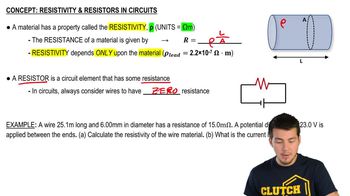
Resistance and Resistivity

Resistance (R) of a wire is determined by its resistivity (ρ), length (L), and cross-sectional area (A) using the formula R = ρL/A. Resistivity is a material property that remains constant for a given material, while resistance changes with the wire's dimensions. Understanding this relationship is crucial for analyzing how changes in length and area affect resistance.
Video consigliato:
Percorso guidato
05:25
Resistivity & Resistors in Circuits

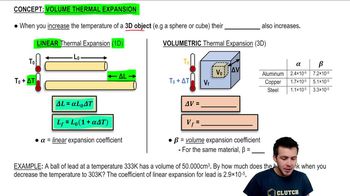
Conservation of Volume

When a wire is stretched, its volume remains constant if the material's density does not change. This means that the product of the cross-sectional area (A) and length (L) before stretching equals the product after stretching. This principle helps determine how the cross-sectional area changes when the wire's length is altered.
Video consigliato:
Percorso guidato
05:21
Volume Thermal Expansion

Effect of Length on Resistance

Stretching a wire increases its length, which directly affects its resistance. Since resistance is proportional to length (R ∝ L), tripling the length of the wire will increase its resistance. However, the cross-sectional area decreases, which further impacts resistance, requiring a comprehensive understanding of how these factors interplay.
Video consigliato:
Percorso guidato
07:40
The Doppler Effect
Pratica correlata
Domanda del libro di testo

The current in a wire varies with time according to the relationship I=55A−(0.65A/s2)t2I = 55 A - (0.65 A/s^2)t^2 . What constant current would transport the same charge in the same time interval?

1174
views

Domanda del libro di testo

A copper transmission cable 100100 km long and 10.010.0 cm in diameter carries a current of 125125 A. How much electrical energy is dissipated as thermal energy every hour?

2090
views
Domanda del libro di testo

A hollow aluminum cylinder is 2.502.50 m long and has an inner radius of 2.752.75 cm and an outer radius of 4.604.60 cm. Treat each surface (inner, outer, and the two end faces) as an equipotential surface. At room temperature, what will an ohmmeter read if it is connected between (a) the opposite faces and (b) the inner and outer surfaces?

1596
views
Domanda del libro di testo

In household wiring, copper wire 2.052.05 mm in diameter is often used. Find the resistance of a 24.0 24.0-m length of this wire.

1901
views
Domanda del libro di testo

A cylindrical tungsten filament 15.015.0 cm long with a diameter of 1.001.00 mm is to be used in a machine for which the temperature will range from room temperature (2020°C) up to 120120°C. It will carry a current of 12.512.5 A at all temperatures. What will be the maximum potential drop over the full length of the filament?

1816
views
Domanda del libro di testo

What is the resistance of a carbon rod at 25.825.8°C if its resistance is 0.0160Ω0.0160 Ω at 0.00.0°C?

1894
views