Ch 44: Particle Physics and Cosmology
Young & Freedman Calc - University Physics 14th Edition
Young & Freedman Calc14th EditionUniversity PhysicsISBN: 9780321973610Non è quello che usi tu?Cambia libro di testo
Capitolo 44, Problema 21

If a Σ+Σ^+ at rest decays into a proton and a π0π^0, what is the total kinetic energy of the decay products?

Guida verificata passo dopo passo
1
Identify the conservation laws applicable to the problem: Conservation of energy and conservation of momentum. Since the Σ^+ is initially at rest, the total momentum of the decay products must also be zero.
Write the energy conservation equation: The rest energy of the Σ^+ particle is equal to the sum of the rest energies of the proton and π^0, plus the total kinetic energy of the decay products. Use the equation: EΣ=Ep+Eπ+Ktotal, where EΣ is the rest energy of Σ^+, Ep and Eπ are the rest energies of the proton and π^0, respectively, and Ktotal is the total kinetic energy.
Determine the rest energies of the particles using their masses and the equation E=mc2. The mass of Σ^+, proton, and π^0 can be found in a particle physics reference table.
Apply the conservation of momentum: Since the Σ^+ is at rest, the proton and π^0 must move in opposite directions with equal and opposite momenta. Use the relationship between momentum and kinetic energy: K=p22m, where p is the momentum and m is the mass of the particle.
Combine the energy and momentum conservation equations to solve for the total kinetic energy of the decay products. This involves substituting the rest energies and solving for Ktotal.

Risposta video verificata per un problema simile:

Questa soluzione video è stata consigliata dai nostri tutor come utile per risolvere questo problema.
Durata del video:
1m

Concetti chiave

Ecco i concetti essenziali che devi comprendere per rispondere correttamente alla domanda.

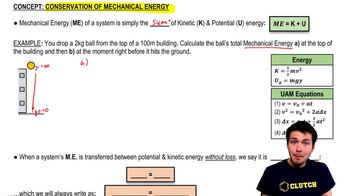
Conservation of Energy

In any physical process, the total energy before and after the event must remain constant. In the case of particle decay, the rest mass energy of the initial particle (Σ^+) is converted into the kinetic energy of the decay products (proton and π^0). This principle allows us to calculate the kinetic energy of the products by considering the mass-energy equivalence given by Einstein's equation, E=mc².
Video consigliato:
Percorso guidato
06:24
Conservation Of Mechanical Energy

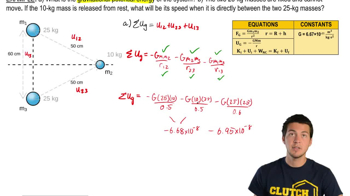
Rest Mass Energy

Rest mass energy is the energy contained in a particle due to its mass when it is at rest. For the Σ^+ particle, this energy can be calculated using its mass and the speed of light. When the particle decays, this rest mass energy is transformed into the kinetic energy of the resulting particles, which is crucial for determining the total kinetic energy of the decay products.
Video consigliato:
Percorso guidato
8:39
Energy Conservation in Three-Mass System

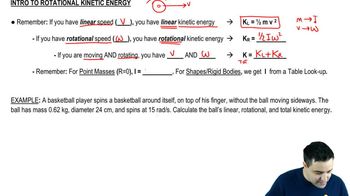
Kinetic Energy of Particles

Kinetic energy is the energy that an object possesses due to its motion. In particle physics, the kinetic energy of decay products can be calculated using the formula KE = 1/2 mv² for non-relativistic speeds or using relativistic equations when speeds approach the speed of light. Understanding how to calculate the kinetic energy of the proton and π^0 after the decay is essential for solving the problem.
Video consigliato:
Percorso guidato
06:07
Intro to Rotational Kinetic Energy